Woof! Woof! How do I stop that dog from barking?!
The noisy dog is the bane of neighbors everywhere. Forget the crazy kid parties, and the motorcycles without a muffler; it is the barking dog that causes the majority of neighborhood arguments, and noise complaints.
So why do dogs bark, and how can we stop that barking behavior?

Why Do Dogs Bark?

- Warning. Dogs may bark to warn others to stay away from his belongings, or his space.
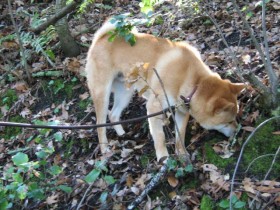
- Alert. Guard dogs vocalize to alert pack members of interesting, or possibly dangerous events. For example, my Shiba Inu will bark whenever he sees or hears something unexpected. He stops, once I come over to check things out.
- Defensive. Dogs may use their bark to scare away possible threats.
- Boredom/Frustration. Dogs that are left alone for long periods of time, bark because they are bored and frustrated. When dogs have pent up, hyper energy, that they are unable to release through exercise, they may bark and charge at the fence.
- Stress. Fearful dogs may become highly stressed, when people or other dogs invade their space. As a result, they may vocalize and lunge, to scare people or other dogs away. Dogs with separation anxiety may bark, whine, and cry, when their owners leave.
- Excitement. Some dogs bark when they are playing or greeting people, because of excitement.
- Attention. Finally, dogs will also bark to get attention. Many owners give attention or affection to their dog, when he vocalizes. This becomes a reward to the dog, which causes him to keep repeating his barking behavior.

1. Dog Obedience Training
When dealing with a noisy dog, remember that barking is often a symptom of some other problem.
Contrary to common belief, dogs do not bark just to annoy us and our neighbors, nor do they do it because of spite or vengeance.
The best way to stop dog barking, is to identifying the root of the behavior. Once we deal with the source of the problem, the “woof, woof” symptom will disappear.
First, we need to be around to observe our dog. We want to identify –
- What starts our dog barking, for example the postman coming,
- Why our dog barks, for example to protect his territory, and
- Whether our dog is rewarded for his barking, for example the postman walking away.
Once we understand these three things, we can develop a plan to retrain our dog. During the retraining process, do not leave him alone where he can practice, and be rewarded for his barking behavior.
Here are some training techniques to stop dog barking:
a) Teach our dog the “Quiet” command.
When our dog starts barking, bring out a really high priority treat, say Quiet, and give the appropriate hand gesture in front of his face.
The smell of the treat will engage his nose, and the hand gesture will briefly startle and distract him. This will probably cause him to stop barking briefly. As soon as he stops, mark the behavior (Yes) and treat him.
Keep practicing this until he understands the command. Then, we can slowly increase the duration of the Quiet command, before treating.
We can hasten the training process by initiating the bark trigger ourselves, for example by ringing the doorbell, squeaking a toy, or playing a recording of sirens.


b) Ask for an alternative command.
In addition to Quiet, we can also ask for other commands that are inconsistent with barking.
For example, we may ask for a Down command, because dogs do not normally bark when they are lying down.
In fact, it is even better to use the Go to Mat command, which gets our dog to move to his bed and lie down. In this way, he moves away from the trigger object, to a location where he feels comfortable and safe.


c) Distract our dog.
We can also distract our noisy dog by engaging him in an alternative activity. For example, we can play a game of tug, or give him a food toy, so that he is not focused on the bark trigger.
It is best to consistently establish a routine for our dog, so that every time he starts to bark, we get him to go to his bed, and play with his food toys. If we repeat this often enough, he will automatically perform this behavior instead of barking.
Note – For retraining to work, it is crucial not to let our dog practice his barking behavior when we are not around. If he practices unsupervised barking, and is inadvertently rewarded for it (e.g. by the postman leaving), he will keep repeating that behavior. With more practice, it will become a habit, and be more difficult to stop.
When we are not around to supervise, crate our dog in a quiet section of the house, and put the radio or television on, to mask the noise from outside. Only do this for short periods of time (< 3 hours). If we will be away for a longer duration, then consider dog daycare or dog walking.

2. Dog Daycare or Dog Walker
Retraining our dog to stop barking, may require a fair amount of supervision and time. While we are at work, we can consider putting him in dog daycare. Alternatively, we can hire a dog walker to take him on group walks, at the park. Both these activities will keep him engaged, well-exercised, and prevent him from practicing his barking behavior.

Note that daycare or dog walking does not train our dog to stop barking.
It just removes him from the bark triggers, and gives him other activities to keep him engaged. If we stop these activities, he will likely start barking again. However, daycare or dog walking are great ways to prevent him from practicing his barking behavior, during the retraining process.
While it does not retrain our dog, it at least keeps the problem from getting worse.

3. Anti-Bark Collars


From Amazon.com
Anti-bark collars are a popular way to address dog barking issues. These collars are convenient, because they automatically deliver an unpleasant sensation to the dog, when he barks. In addition, the strength of the unpleasant stimulus is increased, if he escalates the frequency and volume of his vocalizations.
There are two types of anti-bark collars, a spray collar and a shock collar.
The spray collar automatically sprays the dog’s face with citronella when he barks. If he escalates his barking, a stronger spray is delivered.
The shock collar automatically delivers an electric shock to the dog’s neck, when he barks. The more he barks, the stronger the shock. Sometimes, marketeers refer to these collars as stimulation collars, gentle training collars, and other more people friendly terms, in order to make a quick sale. Do not be fooled by these sales gimmicks.
All anti-bark collars work by punishing the dog for barking.
They do not address the root of the problem, but instead try to suppress the barking behavior through the delivery of an aversive stimulus, for example, pain. As with many other aversive training methods, these collars run the risk of causing aggression in dogs, and other behavioral issues.
For example, our dog may bark every time the postman arrives. This would cause an electric shock to be automatically delivered to his neck. Rather than associate the pain to his barking behavior, he may associate it to the postman instead. This may ultimately cause him to become aggressive toward our innocent mail carrier.
If we *do* decide to use an anti-bark collar, it is perhaps best to only use the spray collars, or citronella collars. Studies (Steiss, Soraya) show that shock collars do not work any better than the spray collars, and they have a much greater likelihood of encouraging aggression in dogs.
When it comes to calming “nuisance-barking” dogs, a spritz of fragrance under the chin is more effective than electric shock, a test by the Animal Behavior Clinic at Cornell’s College of Veterinary Medicine has found.
~~[Cornell Chronicle]
There are also ultrasonic bark deterrent devices. However, since this affects all dogs in a given area (including dogs who are not barking), it has gotten poor reviews. Punishing dogs that are not showing any undesirable behaviors can lead to stress, anxiety, and even more behavioral issues down the road.
Shock collars are commonly used by dog veterans, during highly supervised training sessions, and solely for off-leash distance work. Leaving a shock anti-bark collar on an unsupervised dog, for protracted periods of time, is dangerous, and may cause physical and/or mental harm.

Make sure to monitor our dog closely when we use an anti-bark collar.
Watch out for signs of increased aggression, stress, fear, or other behavioral issues. Set up a web-cam to record him, so that we may observe how he responds to the collar when he barks. Some dogs become extremely stressed or frustrated, and may even escalate their barking behavior.
Remember that anti-bark collars work, by suppressing the barking behavior, and does not address the root of the barking problem.
Even though it may stop dog barking in the short-term, the problem may reoccur once our dog gets habituated to the spray or electric shock. It also increases the dog’s stress level, and lowers his quality of life.

4. Surgical Debarking
Surgical debarking, debarking, or bark softening, is a surgical procedure where tissue is removed from a dog’s vocal chords, to reduce the loudness of his barks.
Most debarking procedures do not completely remove a dog’s vocalizations. Dogs that are debarked, usually have a huskier, softer bark that can only be heard at close range.
Surgical debarking is a controversial subject, and many consider it to be inhumane.
As with anti-bark collars, surgical debarking does not address the root of the barking issue. Instead, it may add stress to the dog because he is now silenced. The dog may feel more vulnerable, and may be more likely to use his bite, since his bark is no longer available.
Because of these reasons, surgical debarking should only be considered as a last resort option; when the only other alternative is euthanasia. Take the temperament of our dog into account, and consider how this process may affect his long-term quality of life.
Debarking is illegal in England. In the United States, debarking laws are determined on a state by state basis. Currently, it is only illegal in Ohio.
I used to like dogs until moving to a tiny community with many dogs in particular next door neighbors on both sides whose dogs will not shut the fk up. During the night is worst for me. I guess its the owners i should “hate” for allowing this,despite my complaints. I no longer find dogs/puppies cute,but annoying. I used to hace a dim view of “debarking” surgery. With the aggravation,anxiety and interrupted sleep and having to have white noise at all times when home, nipping their noiseboxes sounds appealing.
hi, i have gsd mix 5 month old puppy. i have problem is aggresive toward stranger and dogs . how to stop it now thank you
With my Shiba Inu, I did dog-to-dog desensitization exercises to help him be more comfortable around other dogs and dog-to-people desensitization exercises to help him be more comfortable around people. I did these exercises in a structured environment and under the supervision of a professional trainer.
More on dog socialization.
ASPCA article on puppy socialization-
https://www.aspca.org/pet-care/virtual-pet-behaviorist/dog-behavior/socializing-your-puppy
Dog behavior is very context dependent and there are many different types of aggression, so each dog and situation are different. In cases of aggression, it is best and safest to get help from a good professional trainer/behaviorist.
https://www.aspca.org/pet-care/virtual-pet-behaviorist/finding-professional-help
https://apdt.com/pet-owners/choosing-a-trainer/
Hi,
My three year old Texas Heeler is very reactive indoors as well and I would so appreciate some advice!
Within the last six months or so, Sonny has become unbelievably reactive to anything and everything. He barks constantly at anything that moves, breathes or makes the slightest sound. The package that arrived in the mail is something to run from in terror once the lid is opened due to the sounds. Fireworks and popping noises cause intense fear and even shaking (yes, as a puppy I did desensitize him to these sounds). Movement from other family members upstairs are barked and growled at. The cats are constantly being barked at and chased. And Sundance is just not listening to me anymore. I have been completely overwhelmed trying to reign him in. He is very startling.
I feel like he is just no longer respecting me as the leader of this “pack” and I really don’t know how to gain that respect back. I can’t have a dog this out of control. Walks are stressful too as he spends the first 15 minutes dragging me around. And Sundance is a VERY smart dog! He can respond to 24 different commands (all of which I taught him)! So it’s not that he can’t learn…
If you could give me some advice in this area or direct me to some videos/articles on how I might handle this, I would be sooooo grateful! I tried so hard to mold a stable, calm companion and instead I have an out of control 75 lb. dog. Any help would be amazing. Thank you so much for taking the time to help me!
What is his daily routine like? What type of training is he used to? How was he desensitized to the various noises and what was his response? Was he totally calm and relaxed with the noises prior to the last 6 months? Did anything different/unusual happen around that time? Were there any changes to your routine or his routine? Were there changes in the neighborhood, e.g. new sounds? Is he eating and drinking normally? Is he showing any other unusual behavior? When was his last vet visit?
Sudden changes in behavior can sometimes be the result of physical pain, discomfort, or some other vulnerability. Physical issues can cause a dog to feel more vulnerable, and thus be more likely to respond with fear and aggression. When there are sudden and large changes in my dog’s behavior, I rule out physical issues first. After I am sure that my dog is physically healthy, then I start looking at other causes.
There are many different types of aggression and fear aggression is very different from dominance aggression. This article from UC Davis has more on dominance and aggression-
http://behavior.vetmed.ucdavis.edu/local-assets/pdfs/The_Truth_About_Aggression__Dominance_dogs.pdf
More on dominance and bad dog behavior.
My younger Husky has a softer temperament, and when she was young, she was fearful of loud noises and unusual things like people on skateboards. When in panic mode, she would pull very hard and try to get away as fast as she can. This has nothing to do with respect, dominance, or inability to learn. She was simply afraid, and when she is too afraid, she switches to instinct mode, and is no longer able to listen or respond.
I help my dog by managing her environment and slowly building up her confidence and trust. I do desensitization and counter-conditioning exercises, I start small and set her up for success, and I very carefully manage her environment so that I do not expose her to more than she can handle.
The more successful and positive experiences she has, the more confidence she gains, the more she learns to trust me, and the better her behavior becomes. Similarly, fearful and reactive events will undermine her confidence and trust, significantly set back training, and worsen her fears and fear behaviors.
When I had problems with my Shiba Inu, I got help from several trainers/behaviorists and I also read up a lot on dog behavior. Dog behavior is very context dependent, so it was helpful for me to have someone observe my dog in his regular environment and routine, help me identify the source of his problem behaviors, and help me come up with a safe and effective plan for retraining. I look for trainers who understand operant conditioning principles and the different forms of aggression.
https://www.aspca.org/pet-care/virtual-pet-behaviorist/finding-professional-help
http://shibashake.com/dog/finding-a-dog-trainer
How I deal with my dog’s bad behavior.
Where I get dog behavior information.