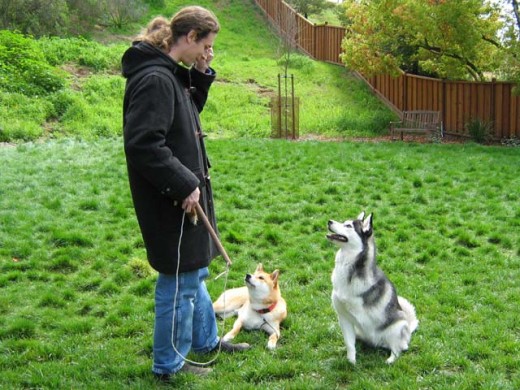
Cesar Millan is the host of the popular show the Dog Whisperer on the National Geographic channel. Cesar is a charismatic and very entertaining host, and he has made The Dog Whisperer into a big favorite amongst dog owners. As a result, he has many fans that implement his techniques on their house pets.
However, there are some who feel that Cesar’s techniques are overly harsh and inappropriate for novice trainers (most pet owners).
In this article, I examine Cesar’s approach and discuss its pros and cons.
Cesar Millan – The Good
1. Cesar Millan educates people on being a good pack leader.
To be a good pack leader Cesar Millan talks about setting rules and boundaries for your dog including door manners and always walking your dog slightly behind you. He also emphasizes the importance of maintaining calm and assertive energy which made a huge difference with my Shiba Inu.
Since dogs live in a human world, they need us to provide them with a degree of structure so that they feel safe and so that they do not harm others or themselves. They also need a balanced leader who is able to protect them, and show them how to behave in stressful situations.
These messages are extremely important, especially in this day and age where dog owners tend to overly spoil their dogs by letting them do whatever they want. Uncontrolled dogs may become dangerous and unhealthy. Ultimately. they may have to be destroyed because nobody taught them how to behave in a human world.
2. Cesar Millan gets people to fulfill their dogs’ needs, not just their own.
Cesar Millan gets people to fulfill their dogs' needs, not just their own.
Most dog owners are very aware of how dogs help us live happier, and fuller lives. What is often forgotten is that dogs have needs of their own.
Cesar Millan talks about understanding a dog’s needs and helping him be a happy, well-balanced dog through dog exercise and dog discipline. He also shows people that once they help their dogs burn some energy, the dogs are a lot more well behaved.
Given the unrealistic expectations of dogs that are propagated by some dog movies, it is a big advantage to dogdom to have Cesar Millan spreading this message about a dog’s needs to audiences everywhere.
3. Cesar Millan shows people how to improve their dog’s behavior regardless of breed and background.
Some dog breeds have developed a really bad reputation, especially the Pit Bull Terrier. Cesar Millan does a really good job in showing people that all dogs can be rehabilitated regardless of breed and background.
His own pack consists of many Pit Bulls and Rottweilers, both of which have gotten a bad reputation for being dangerous and aggressive dogs. Cesar Millan frequently uses many Pit Bulls from his pack to rehabilitate other dogs. His Pit Bulls are calm, balanced, and very non-reactive even when faced with extremely hyper dogs.
There are a large number of Pit Bulls in shelters today, and they have a difficult time finding homes because people are afraid to adopt them. Cesar Millan and his Pit Bull sidekick Daddy do great things to combat the negativity associated with that breed.
Cesar Millan’s message that every dog can be rehabilitated, gives hope to people with difficult dogs, and reduces the number of shelter surrenders. His hopeful message could also encourage people to adopt shelter dogs, and give them a second chance.
4. Cesar Millan uses his pack of dogs to teach other dogs and improve their behavior.
Cesar Millan shows people that the best teacher for a dog, is often another dog.
While we may try and learn canine body language, we will never be as adept at using it as a canine. Of course the doggy teacher must be calm and very balanced.
When looking for a trainer, try and find one that has some calm, balanced, dogs that can work with you.
Cesar Millan, The Good - When looking for a trainer, try and find one that has some calm, balanced, dogs that can work with you.
Cesar Millan – The Bad
1. Cesar’s Way or the highway.
Cesar's Way or the highway.
Cesar Millan has an extremely confident, charismatic, and alpha personality that makes him very successful. Unfortunately, a side-effect of this, is that people may just follow his techniques and not explore other alternatives.
His emphasis on large breed dogs and aggressive dogs, as well as his approach to dog psychology through aversive methods, perpetuates some inaccurate myths on dog training, including:
- You cannot train large breed dogs with reward methods.
- You cannot train aggressive dogs with reward methods.
Because Cesar Millan is so widely watched and so widely recommended by dog breeders, dog owners, and other dog professionals, there is a huge network effect that propagates and perpetuates these myths. This can lead to widespread tunnel vision that ultimately does a disservice to dogs, especially dogs that are incorrectly diagnosed with aggressive or dominant behavior.
There are many trainers who have successfully rehabilitated aggressive dogs using only reward dog training.
I think that Cesar Millan can combat some these misconceptions by always reminding his audience to keep an open mind and to use a wider range of techniques in his Dog Whisperer program.
2. Cesar Millan does not place enough emphasis on owner discipline.
Cesar Millan greatly emphasizes dog discipline, but he is a lot less strict with their owners. Dogs with problem behaviors need a lot of attention. Frequently, owners must put in a lot of time and effort to help their dogs reach a happier and more balanced state.
The format of The Dog Whisperer show is such that Cesar has to show results quickly to make the program interesting and engaging. Often times there is a timer which shows how Cesar Millan solves a problem in minutes (5-15 minutes), that will actually take a lot of time and effort to truly become a learned behavior.
Even though Cesar Millan may sometimes say that changing a dog’s behavior takes time, his Dog Whisperer program shows the opposite.
This is in contrast to shows like It’s Me or the Dog, where there is a lot more emphasis on owner participation in the dog rehabilitation process, and the unfortunate consequences that may occur when owners fail to put in the effort.
3. Cesar Millan does not spend enough time discussing dog training equipment.
Cesar Millan does advise his clients to put a dog’s collar high up on the neck, close to the head and ears. He will occasionally uses his Illusion collar to keep a choke collar from sliding down a dog’s neck.
Frequently, however, Cesar Millan just goes with whatever the owner is using, thereby implicitly agreeing with the owner’s dog equipment choice. Given that Cesar Millan is the expert, it would be helpful to have more of a discussion on the pros and cons of dog training collars .
Training collars (e.g. prong collar, choke chains), should not be left on a dog for long periods of time; they should be put on for a walk or a training session and removed otherwise. Definitely remove a training collar when your dog is off-leash, especially when he is interacting with other dogs. A choke chain may get caught while a dog is playing or running around which may result in injury or death.
Prolonged use of choke chains may cause injury even if used correctly. For safety, use a training collar for a limited amount of time (several weeks) and then switch back to a flat collar once your dog understands the rules of walking.
The Illusion collar is a modified choke collar, and the risks of using such collars should at least be mentioned.
4. Cesar Millan supports a more dictatorial rule and does not explore other forms of pack leadership.
Cesar Millan offers little to no exploration on what type of leader we should be.
It is important for us humans to become pack leaders of our dogs but an important corollary question is what leader we should be.
Cesar Millan seems to support something more akin to a dictatorship, where everything the leader says goes, and not following a rule, brings about some kind of disciplinary action whether it be a leash jerk, a finger poke, or an alpha roll. The dog is always expected to walk close to but behind the human, and there is very little stopping to smell the roses.
Between a dictatorship and no leadership is a wide range of other possibilities.
Take into account your own temperament and the temperament of your dog to determine the best type of relationship for you.
5. Cesar Millan downplays the dangers of aversive dog training.
Shiba Inu Sephy does not respond well to aversive techniques.
Cesar Millan uses a variety of aversive training methods including, alpha rolls, leash jerks, and finger pokes. He often tells owners that these techniques do not cause the dogs any pain or stress, it is just meant to get the dogs’ attention. There is also an implication that these techniques are appropriate and humane because wolves do that to other wolves, or dogs do that to other dogs.
Both of these statements are not very accurate.
All aversive methods cause an unpleasant sensation, or they would not work. An aversive technique may sometimes cause stress and fear in a dog, which is why the dog avoids that behavior in the future.
Aversive training can also backfire if not executed with the correct force, with the proper timing, and with the proper redirection. When not executed properly, aversive methods may cause additional behavioral problems in dogs including aggression.
This University of Pennsylvania 2009 study shows that 1 in every 4 dogs that are trained with aversive methods exhibits aggression during training.
Given Cesar Millan’s popularity, there are a large number of people who follow his dog behavior modification techniques just from watching The Dog Whisperer on television. Cesar Millan should at least mention some of the dangers of using his aversive methods.
As a dog owner, I would like accurate information on dog obedience training, rather than sugar coated versions.
Thank You for Your Comments
Thank You for Your Comments.
I would like to thank everyone for leaving comments and participating in this discussion. You have made me think a lot about dogs, dog relationships, dog training, and how to solve problem dog behaviors.
Many people feel strongly about dog training or dog behavior modification techniques, because they love their dogs very much and want what is best for them. That is why there is much controversy surrounding Cesar Millan, and the aversive dog training methods that he uses. I have noticed, however, that he is using fewer aversive methods in his more recent Dog Whisperer episodes, and is using a bit more rewards; which I think is a really good thing.
Some people consider aversive methods to be dog cruelty. That is, however, a moral judgment, and therefore best left to the theologians.
I started out with Cesar Millan’s aversive techniques on my first dog.
When I tried to switch over to reward dog training, many of the people that I sought to get advice from called me all sorts of names, including cruel and harsh. Luckily, there were some that gave me good advice, and reward methods worked out very well for my dog in the end. I now only use reward obedience training on all my dogs, but messages about exercise, discipline, and energy still apply whichever techniques you use.
Please understand that this article is not about name calling, finding fault, or anything else, it is about gathering information, and having discussions, so that we can make the best decisions for our dogs.
I believe that you do not need to reject everything that Cesar Millan says just because there are some things you disagree with; and similarly, you do not need to follow everything that Cesar Millan says, just because there are some things you agree with.
Thank you for making me think more deeply about these issues. More comments are always greatly appreciated.
More Cesar Millan
- Cesar Millan’s Positive Reinforcement Techniques
A look at why Cesar Millan is so successful and his use of positive reinforcement techniques. - Dog Psychology and Cesar Millan
What is dog psychology and how is it related to dog training and dog behavior modification. - Cesar Millan, the Dog Whisperer’s Most Controversial Topics
Common points of contention between Cesar Millan supporters and critics. - The Dog Whisperer vs. Victoria Stilwell
A comparison of Cesar Millan’s aversive based, dog training techniques, with Victoria Stilwells reward based methods. - Cesar Millan’s Dog Training Techniques
An analysis of the dog training techniques most used by Cesar Millan; including alpha rolls, leash jerks, and no look, no touch, and no eye contact.
Interesting Articles on Cesar Millan
- American Humane Association: ‘Dog Whisperer’ Training Approach More Harmful Than Helpful.
- The Anti-Cesar Millan: Ian Dunbar.
- The New York Times: "Pack of Lies".
- Dog Whisperer to Critics: My Techniques Are "Instinctual"
- The New Yorker: What the Dog Saw by Malcolm Gladwell.
- Wikipedia: Cesar Millan.
Cesar Millan Discussion Threads
- Yelp: Cesar Millan dog ‘rehabilitating’ techniques inhumane? (good mix of Cesar positive and negative)
- Dogster (mostly Cesar positive)
- I Remember Love Forum (mostly Cesar positive)
- Dog Explorer (mostly Cesar negative)
Hello Christina,
Thanks for your very well thought out comment.
You are absolutely right that aversive techniques can work. This has been proven by many years of study in animal psychology. Both reward techniques and aversive techniques can be used to modify dog behavior.
However, aversive techniques are a lot more risky. As you say, it needs to be applied with the right timing, right technique, right energy, and on the right dog. Applying aversive techniques, especially physical aversive techniques on the wrong dog will bring bad results for both dog and owner.
This message is a stroke of genius. It allows the show to feature more risky aversive techniques without putting the network and others at risk for any financial or personal liability.
To me, it is a strange message. Which techniques should I not attempt? Some of them? All of them? In that case, is the show only for entertainment and I should just ignore everything that Millan says?
Millan is charismatic, and a very effective communicator. I think it is only natural that we will follow the advice of someone whom we respect and who comes across as so effective over the t.v.. I see people alpha rolling their dogs here, there, everywhere – often times for exhibiting normal dog behavior.
Very interesting example! A speeding ticket, to me, is more like a reward technique – you are taking away a resource – i.e. money or freedom to drive from someone who is exhibiting an undesirable driving behavior.
This is very different in my mind compared to a physical aversive technique. There, you are adding an aversive stimulus – often pain – to deter a behavior.
You bring up a very good point here – physical aversive techniques are often based on the degree of force applied. Too little force, and the dog will just ignore it, too much force and the dog will become overly stressed and be unable to learn. The degree of pain felt by the dog, I imagine, will be based on the temperament of the dog and the level of force applied.
Some sensitive people ‘feel pain’ when others may not. Some dogs get very stressed even from a yell and no physical touch at all. Pain/stress is relative.
You are right that a tap can be used to startle someone if it is wholly unexpected – but this would only work if you use the tap very rarely. The ability to startle is quickly lost in cases where the ‘touch’ is used over and over again. In those cases, it is the amount of ‘force’ that matters.
I write more about the magical touch here is you are interested …
http://www.shibashake.com/dog/the-squirrel-instinct-can-it-be-retrained
Also dogs have great control over the placement and force of their bites. When they are young, they learn what level of force is appropriate during play because if they hurt their siblings, there is a squeal and play stops. Through this process dogs learn bite inhibition which is a very useful skill to have.
Your comment really made me think and it made me realize that people’s opinions on dog training techniques are often highly determined by their own experiences with their dogs – that is only natural. You have had great success with alpha rolls etc – and so in your experience they are a useful and effective tool. I, on the other hand, have had bad experiences with aversive methods and so I have a negative perception of them.
It is just not possible to stay truly objective when it comes to our dogs – similar to our kids.
One thing we can do though is to look to scientific studies that have been conducted on dogs and other animals.
Another thing that has been interesting for me is to also look at what different dog-breed communities say about the techniques in general. There definitely seems to be a general slant towards or against the techniques depending on type of breed.
This makes sense because certain breeds have temperaments that are very unsuited towards aversive methods – including truly stubborn and truly independent breeds.
Aversive techniques can work. If they didn’t work at all – there would be no issues because nobody would use them. The question, I think, is not whether aversive techniques work but whether there are alternative techniques that work better.
Thanks for the very interesting discussion.
Hi! I think your blog did a pretty good job on the “goods” but I do disagree with a couple of your points on the “bads.” Re: point 1, I agree. Cesar doesn’t leave much wiggle room. On point #2, I strongly disagree. Cesar says all the time in his shows that most problems aren’t with the dogs, its with the owners. I enjoy watching him listen to an owner that he thinks is out of their minds as submissive to their dogs, especially the amusement you can see when he’s addressing owners of territorial or aggressive toy breeds. Point 3 is accurate, he doesn’t spend much time on equipment. And point 4, also pretty accurate. Point 5 of downplaying the role of “aversive training methods.” Every single episode commercial break return warns not to attempt these techniques without the help of a professional. I agree with you that you have to know your dog and let common sense prevail in this area. As for causing discomfort or unpleasant sensations for the dog, I think that this is a teaching tool for any situation. If we get a speeding ticket in our adult life, it causes a degree of discomfort. A “bite” with the hand that Cesar utilizes hardly causes true pain to my dogs, when they play with one another they use more force than that. He encourages with alpha rolls to make it a pleasant experience for the dog once calm-submissive.
I have used his techniques to great success in my formerly “incorrigable, unsocialized, fearfully aggressive” dog. I am happy to report that Cesar’s methods when applied consistently over time worked wonders for him. He is more than happy to offer his belly for a rub now, has a very happy life with his fur sister and fur cousins, when he’d previously been unable to be anywhere near other dogs d/t his aggression. He formerly couldn’t be around anyone but our family members as he’d bitten guests, and he’s now free to roam the house when company is present. I could go on about his success but I will stop there. Suffice it to say thanks to Cesar, we have a much happier family with our dog who we had been considering euthanizing prior to his rehabilitation. He was a major liability and is now a well-adjusted member of our family. And yes, the original problem was me, his owner and my fears that traveled down the leash to him!
UK animal welfare, behaviour, training and veterinary organisations1 are warning of the possible dangers of using techniques for training dogs that can cause pain and fear, such as some of those seen used by Cesar Millan, who has announced a UK tour next year.
The organisations have joined forces to voice their serious concerns about techniques which pose welfare problems for dogs and significant risk to owners who may copy them. These concerns are shared, and the statement supported, by similar organisations around the world2 and in continental Europe3.
Aversive training techniques, which have been seen to be used by Cesar Millan, are based on the principle of applying an unpleasant stimulus to inhibit behaviour. This kind of training technique can include the use of prong collars, electric shock collars, restricting dogs’ air supply using nooses/leads or pinning them to the ground, which can cause pain and distress. The use of such techniques may compromise the welfare of dogs and may worsen the behavioural problems they aim to address, potentially placing owners at considerable risk. A number of scientific studies have found an association between the use of aversive training techniques and the occurrence of undesired behaviours in dogs.
1 Dogs Trust, The Blue Cross, Royal Society for Prevention of Cruelty to Animals (RSPCA), The Blue Dog, Wood Green Animal Shelters, World Society for the Protection of Animals (WSPA), The Kennel Club, Raystede Centre for Animal Welfare, Canine Partners, UK , Association for the Study of Animal Behaviour (ASAB), Association of Pet Behaviour Counsellors (APBC), Association of Pet Dog Trainers, UK (APDT, UK), UK Registry of Canine Behaviours (UKRCB), Companion Animal Behaviour Therapy Study Group (CABTSG), British Small Animal Veterinary Association (BSAVA) and British Veterinary Association (BVA).
2 Australian Veterinary Association (AVA), Australian Veterinary Behaviour Interest Group (AVBIG), American Veterinary Society of Animal Behavior (AVSAB), American College of Veterinary Behaviorists (ACVB), The International Association of Animal Behavior Consultants (IAABC) and The Certification Council for Professional Dog Trainers, Inc. (CCPDT)(USA).
3 European Society of Clinical Veterinary Ethology (ESCVE), European College of Veterinary Behavioural Medicine – Companion Animals (ECVBM-CA), the Flemish Veterinary Working Group on Ethology (VDWE) and Norwegian Association for Pet Behaviour (NAPB) Norsk Atferdsgruppe for Selskapsdyr (NAS).
The organisations believe that the use of such training techniques is not only unacceptable from a welfare perspective, but that this type of approach is not necessary for the modification of dog behaviour. Dog trainers all over the UK use reward-based methods to train dogs very effectively. Where dogs have behaviours which owners find unacceptable, such as aggression or destruction, qualified behaviourists achieve long term changes in behaviour through the use of established and validated techniques of behaviour modification without subjecting dogs to training techniques which may cause pain or distress.
We urge dog owners to carefully consider the help they choose to train their dogs or tackle behavioural problems. Anyone can call themselves a behaviour expert, but we believe that only those with a combination of appropriate qualifications, up to date knowledge as well as skills and experience should be treating dogs, and should only do so in a way which does not put the welfare of the dogs at risk.
Further information on:
• the misconceptions which underlie the use of aversive training techniques
• the development of behaviour in dogs
• the problems associated with the use of aversive training techniques
• finding a suitable trainer or behaviourist
can be found at: http://www.dogwelfarecampaign.org
Hi Amanda,
Very well said. As long as we are flexible, and keep our dog’s interests and needs as our top priority, everything should work out well.
I feel the same way.
Sadly dogs have very few rights and protections in our laws. Even if they are attacked by another dog, there is very little we can do. And certainly they have almost no rights when it comes to a human.
I have a pitbull, a pitbull PUG mix, and a basset hound.
With my Pitbull I found that treat training caused him to be way more excitable and very difficult to work with. I adopted some of Cesars methods “the Shh” and the use of the “finger nip”. I have found that using the shh and hand nip seems to work incredibly well with him as long as it is properly timed and applied,(if I’m off by a few seconds he just seems confused) and I have now gotten to a training level with him where I am using him for hearding as well as starting his training as a search and rescue dog.
With the pit mix I’ve used treat and affection trainig- With him I have also adopted some of Cesars methods- and again they have worked well. The use of a treadmill, the “shh”.
I do firmly believe that each dog is different, and each dog has to be trained differently. I personally refuse to use a choker collar on my dogs, and would rather exert the extra hours of training and practise to achieve my goals with my dogs.
Great job on writing such a great article.
Hello SPr!te !s mY f@voRitE
Thanks for dropping by. And no need to apologize – there are lots of comments so I am sure nobody reads through all of them. And I appreciate all comments, so it is never too late to leave one.
“Reenforcment, in my opinion, is meant for tricks, not for rehabilitation.”
I think many people think this from watching Cesar Millan. However, reward techniques can be used to both train good behaviors (what you call tricks) and to stop bad behaviors (what you call rehabilitation). Even Cesar Millan will sometimes use food in his rehabilitation process.
Both reward techniques (which most people associate with food but it is much more than that) and aversive techniques (leash corrections, alpha rolls) are based on a behavioral psychology process called conditioning.
Here is an article of mine on dog psychology and conditioning that may be of interest -
It deals with conditioning as well as what you call nature’s methods, etc.
“A touch or a yank on the collar at the wrong time is not going to send the dog into a deadly and irreversable state of mind”
Studies show that aversive methods when used incorrectly can encourage even more aggression in dogs whereas reward methods did not encourage any aggression.
“If people are dumb enough to missenterpret what is said than shame on people”
Nobody is perfect and people will always make mistakes. When people make mistakes in dog training, it is often the dogs that pay the price for those mistakes. Aversive techniques are a lot more risky than reward techniques and that should at least be mentioned so that people understand the risks that they are taking with themselves and their dogs.
And you definitely made a lot of sense even at 2 am in the morning
Happy summer.
Ok, I didn’t read all of the comments, so I’m probably repeating what has already been said. I also apologize for commenting so late. I just feel the need to say something. Here is goes…
I am a big fan of Cesar Millan and his ideas (etc.). As for positive reenforcement, when the dog achieves a calm and submissive state, he/she is reenforced with affection which he/she has earned. Reenforcment, in my opinion, is meant for tricks, not for rehabilitation. Again (I havent really read any replies from you over this subject) at the beginning of the show, it is stated that you should consult a professional blah blah blah, you know what I mean. Therefore people who are using his methods on unstable/aggresive dogs are not Cesar Millan, and ’should consult a professional’. When walking a dog, I believe that the pack leader (me!) decides when he/she “stops to smell the roses” (idk). No matter what state of mind the dog is in, it can always recover. A touch or a yank on the collar at the wrong time is not going to send the dog into a deadly and irreversable state of mind. What you are calling aversive methods are methods that nature uses on dogs, but nature knows how to use them, and the dog is rewarded with a balanced state of mind. (aversive method using) Professionals are the closest we can get to nature, but affection is also given as a reward.
“The Cesar way is not the only way”
-Cesar Millan
If people are dumb enough to missenterpret what is said than shame on people (lol). Cesar rewrds humans the waay he does becaus they are humans. Dogs are not humans. Dogs are dogs.
If anything I’ve said makes no sense it is probably because I am 14 years old and it’s 2:00 a.m.. I would love to say more but I will try tommorrow when I’m not falling asleep.
Peace Love Music
Im going to bed.
Hey I am super busy lately. Sorry if I don’t respond very quikly. Glad to hear all is well! ttly
Hello drhay,
The methods used for rehabilitation and training are at their root based on behavioral psychology and operant conditioning.Both aversive methods and reward methods can be used for training and rehabilitation.
http://www.shibashake.com/dog/dog-psychology-cesar-millan
“You rehabilitate the dog to lower their aggression, then train them in the proper behavior.”
http://www.upenn.edu/pennnews/current/research/030509.html
You are definitely right that Cesar Millan does use several reward training techniques including body blocks, and no-talk-no-touch-no-eye-contact. However, he often does not present them as reward methods.
http://hubpages.com/hub/Cesar-Milan-Dog-Training-the-Dog-Whisperer
Sometimes he also uses food, but that does not happen very often. Sometimes he also speaks out against reward training and implies that such methods are only appropriate for teaching tricks and not for rehabilitation – which is not true. Both reward and aversive training are based on operant conditioning, and both can be used to shape behavior – whether it is to teach new behaviors or stop old bad ones (what you call rehabilitation).
“but his training methods beyond that seem to be very similar to what 90% of the population does with their dogs anyway.”
Sadly this is probably on the true side. This is because the majority of people use aversive techniques to train their dogs. Traditionally, that was the dominant paradigm used in dog training and more generally in animal training, i.e. using whips and chains on lions, tigers, and bears.
Nowadays, experts have realized that animals including dogs perform better when they are motivated through reward methods. That is why even lions, tigers, and bears are now trained using reward methods.
The dog training world is slowly changing, but popular trainers on television that support the use of aversive methods slow down this process.
Hey RP! Everything is good
Glad you are still visiting HubPages from time to time.
I want to point out something that many negative posts about Cesar across the internet seem to be on the wrong track about. In Cesar’s show it is very clear that the methods he is using are for rehabilitation, not training. To me, these are very different. Most of the dogs Cesar works with are very aggressive, and for most of his clients, this aggression needs immediate rehabilitation. Rehabilitation and training are different things in my mind. You rehabilitate the dog to lower their aggression, then train them in the proper behavior. Cesar frequently advocates reward training in the Dog Whisperer, and mainly uses dominance as a source of rehabiliation. Now I’m not sure of his method for raising a dog from a puppy….but I think there is a clear misconception that Cesar only uses dominance theory when other methods might be more suitable. To sum up: Cesar seems to rehabilitate dangerous behaviors with dominance theory, but his training methods beyond that seem to be very similar to what 90% of the population does with their dogs anyway.
What’s up??
Check out Animal Planet’s Brad Pattison beating up his student’s dog. This guy is one flaming a-hole. http://blip.tv/file/1789530/
” I just like to read myself write
”
lol – you should definitely join Hub then. You can write about most things and even earn some bucks for it
“what if the dog takes that as the owner inciting it to then bark at and charge Millan from the ground?”
Well this would depend on why the dog is doing it. From the clip it seems that the dog is trying to keep people away from the owner woman. So the owner woman would non-mark and then body block the dog away from Millan. This way the dog learns that barking gets him removed from people. The dog should stay away for a bit, and once he is calm he can be invited back in to retry the greeting. If a dog is people aggressive, then I would do desensitization exercises on him.
“Thanks for helping me vent”
Glad I could help. Next time I need to vent, I’ll know where to go
I’d never even heard of HuPages before stumbling on your site. I was just searching for DogWhisperer opinions and hit upon yours, and the chance to admire my own writing was just too good an opportunity to pass up. Some people just like to hear themselves talk — I just like to read myself write
I think putting the little dog on the ground is not a bad idea, but what if the dog takes that as the owner inciting it to then bark at and charge Millan from the ground? If you are walking your dog and it starts barking at someone and chomping at the bit to get at the person do you then ‘put it on the ground’, so to speak, as well, in other words, let it go? The little dog wanted to charge Millan, so enabling it to do so doesn’t make it clear that that behavior is unwanted by the owner, and possibly does quite the opposite. Millan’s approach it seems to me was much less subject to misinterpretation by the dog, which clearly didn’t seem to have a problem with Millan moments later when he was holding the little bugger in His lap.
To your walk-on-water questions 1) and 2), points well taken. As a critic of the media’s Obama-slobberfest, I can certainly see how it looks like I’m guilty of the same offense. Not seeing the entire consultations but rather just the edited TV snippets it’s hard to know if criticisms I might have are really things that are just artifacts of the editing process. I have noted to myself that some of his clients parrot back his expressions in the visit-ending summaries but it doesn’t seem like they actually comprehend the words they are echoing. Kind of like students regurgitating a political science professor’s opinions on a midterm exam because they think it will get them a passing grade, but not really thinking about what they’re spitting up. Sometimes when Millan is explaining things to some people they say ‘okay’ or ‘yes’ or ‘right’ at the end of every other of his sentences, as if they understand, but it’s clear that they Don’t understand, and he just keeps going as if they did. I would like to see him stop in these cases and back up and try again, because it’s these people who keep saying that they’re getting it that are the very ones who are Not getting it. He seems better able to read dogs than to read people in these cases.
My lack of respect for Stillwell is due to my belief that she’s grossly ignorant, but my Disdain for her comes from the pompous attitude with which she presents her nonsense. Millan on the other hand comes across as a man with an admirable humility which allows him to really get into the heads of the people on the show, many of whom you hear describe their encounters with him as life-changing experiences. The DogTown people strike me as simple folk trying to do the right thing but just not the sharpest tools in the shed, and I would love to see Millan spend a couple of days with them or them a couple of days in LA with him, or both, because I do think they would absorb quite a bit of knowledge in the process. Stillwell wouldn’t give Millan the time of day but the DogTown folks seem like they are not at all beyond hope.
Thanks for helping me vent. I appreciate a person adept in the art of disagreeing without being disagreeable, and hopefully am practicing the same.
“when you give your dogs beer, do they turn into Sleepy drunks or Obnoxious drunks?”
LOL – I have no clue because I am a Sleepy drunk so after a few, I am out, and they are doing what drunk dogs do.
You misunderstand. The owner lady was definitely clueless – no ifs, ands, or buts about that. So it is the poking that I disagree with, not the timing or anything else.
All the woman had to do was withdraw her affection by putting the dog on the ground. The dog will soon learn that being aggressive or licking too much gets him ignored, while being calm gets him attention – same end result – no poking.
I do not know how to make my position any clearer, other than just to restate it – I do not have anything against many of Cesar Millan’s methods. I think it is good that he educates dog owners, because many dog owners certainly need the knowledge.
However I disagree with the use of aversive methods on regular house dogs because they are easily misapplied, and when that happens the dog ends up being more aggressive and having even more behavioral issues. If memory serves, you also agreed that many dog owners misapply his techniques.
http://www.upenn.edu/pennnews/current/research/030
And yes reward techniques can also be misapplied, but they are easier to learn and execute (as I have pointed out earlier with the leash correction example).
Since we have had virtual beers together, I hope it is ok to ask you a few personal questions -
1. Do you think that Cesar Millan can do no wrong? If not, then please give me some examples of mistakes you think he has made.
2. Do you think trainers other than Cesar Millan can do no right? You stated that people from DogTown, Victoria Stilwell, etc. are all ignorant. So is there anyone else other than Cesar Millan and his followers who are right?
Btw. have you looked around HubPages much? I think you would enjoy it, given your zest for debate
It was a Joke. Geez, lighten up. I’m curious — when you give your dogs beer, do they turn into Sleepy drunks or Obnoxious drunks?
Back to the instantly-fixed snippy dog the clueless lady was affectionately encouraging: If you can’t see how the owner was the problem, then I give up. One of the many good things about the way Millan gets the dog to stop its bad behavior right away is that for clueless owners, just like for anyone else, Seeing Is Believing, and even for people in denial about how They might be the source of their dog’s issues it’s nigh onto impossible to stay in denial once confronted with the reality of their ‘unfixable’ dog suddenly and contentedly behaviing so Well in front of their very eyes. If you try to use some protracted reward-removal silliness you more than likely run out of time on that first and possibly only visit, and just get an owner whose denial gets re-enforcedl. If you only have one opportunity to snap the owner out of it, as it were, you have to get the dog to demonstrate the good behavior right away. These people watch the show and read the book and still don’t think it will work on THEIR cute little pumpkin, so they continue to exacerbate rather than rehabilitate, but when staring into the face of an undeniable new reality they are provided with the mental ammunition their brain seems to need to overcome the denial force that was ruling their day. Millan recognizes that to fix the dog you must fix the Owner, and really he just fixes the dog in front of the owner to show the owner that it Can Be Done, so stop making excuses for Fluffy and just do it. He knows that without fixing the owner the dog will revert back to its former state once he leaves, so the vast majority of his time is spent explaining it and showing it to Them, so They can maintain or even improve on the behavioral mods he has demonstrated. The old expression says if you can, do, if you can’t, teach, and there’s a lot of trainers out there who haven’t any idea what they’re doing, many of them with pompous academic self-described ‘credentials’, but send them to the hills for a walk surrounded by Millan’s perfectly-balanced pack and I’ll bet they end up wishing they had stayed home and thrown back a few Corona’s instead. Now That’s some reality TV I’d be willing to Pay to see…
Burp…
lol – Calmassertiv, You had to take the one teensy-weensy part of the episode that I disagreed with and focus on that. I really did try to find some common ground
“because I get my rocks off being unconditionally worshipped by a Smart animal”
Perhaps therein lies the difference between Cesar fans and those who are not – I don’t need to be worshipped at all.
Ok I’m off to drink beers with my dogs.
The puppy-mill episode was indeed a good one. Millan’s self-restraint when inside the devil’s den, so to speak, is something I would be hard pressed to duplicate. Being civilized to the breeder/owner who himself behaves so uncivilly towards his animals must have taken a lot of willpower on Millan’s part.
Back to our discussion of reward vs. aversion. Note that this episode also included an interview with that lady with the little snapping dog in her lap, showering it with affection and thus encouraging its obnoxious behavior. She asks for his help, he ‘bites’ the dog a couple of times with his hand, and the dog ‘magically’, in the eyes of the lady, instantly stops the behavior she had been unknowingly rewarding for months. She is totally impressed, the dog is much happier, and the dog ends up liviing a life of affection as reward with Proper timing for its Good behavior and not Improper timing for its Bad behavior. The point Millan tries to make in several episodes is that there is a difference between calmly assertively Correcting a dog and angrily aggressively Punishing a dog. The rapidity of the effectiveness of his Correcting the lady’s dog in the lady’s own office, not hurting the dog in any way, and pointing out how it was the Lady who was actually hurting her dog Psychologically by Not correcting it, is what makes watching Millan in action so interesting. He rehabilitates dog, he Trains humans. And as he also chuckles in so many episodes, it’s the training of the Humans that takes the longest — the dogs almost always get it right away. This is why I like dogs so much — not because I get my rocks off being unconditionally worshipped by some dumb animal, but because I get my rocks off being unconditionally worshipped by a Smart animal. Even dumb blondes can get tiring after a while (although there is something certainly to be said for getting tired on occasion…)
I am definitely against instigating/daring dogs to show aggression. I think that the best way to treat many fear issues is through a slower but more effective desensitization process where the goal is to help the dog slowly make positive associations with objects that were previously fearful or threatening. To be fair, Cesar Millan uses that same “daring” process of triggering aggression – he just follows it up with a correction.
Truth be told, I really have nothing against Cesar Millan – the man. However, I do think that reward techniques are more appropriate for most pet dogs and they are also more appropriate and less risky in the hands of most pet owners. Yes any technique can be misapplied, and that is why education is so important. Cesar does a good job of that but at the same time he also encourages the use of aversive methods. Many of the people who use his methods do not apply them correctly. Ultimately, it is their dog that pays the price.
I just saw the puppy mill episode of Cesar Millan and I really liked that episode. I think that Cesar Millan does not need to use any aversive methods. He does exceptionally well with just reward methods and his natural skill of reading dog body language and his own calm energy. I really liked how he helped that nervous Akita into the crate. It would be great if he did more puppy mill episodes because he gets the message out to the most number of people.
The thing about watching these ‘evaluator’ people is that they not only can’t evaluate, but they actually create and exacerbate the very behaviors they say they don’t want. They take a starving dog, give it a bowl of food, then poke it in the face with a teasing, fearful uncertain approach, in effect Daring, just Daring the dog to assert itself in front of weak energy so as to encourage it to learn to guard its food. You (well maybe not you, but I, at least) can see that the dog is just getting Goaded Into a behavior he had no prior interest in exhibiting, in exactly the way one would use if one Wanted to Create the behavior. Then after Teaching the dog to be aggressive they say See, it’s aggressive, kill it. I’m surprised these people have brains enough to dress themselves and not make messes in the house. The kicker for me is the irresponsibility of Animal Planet’s production staff putting this stuff out like it’s supposed to be educational. Just watch Millan explain and show how he enters back-first into a fearful dog’s cage to slowly gain its trust, then take it for a relaxed and trusting walk outside for the first time in its life, as compared to these Phoenix morons giving full eye contact to the dog cowering in the corner, dragging it out terrified and deciding to kill it. Kudos to National Geographic Channel for showing Millan show how it’s supposed to be done, and shame on Animal Planet for their narrative editorial support of such ‘professional’ ignorance and ineptitude.
You are right about the vets in NY versus Phoenix. Several NY episodes of Animal Cops have the vets rescue dogs from the brink of death, (Buddy comes to mind), investing tons of time and in an inspirational and successful effort, and I’m sure the surplus of animals applies to NY every bit as it does in Phoenix. The DogTown vet, too, goes to great length to save his dogs. Also Houston. The Phoenix story leads the viewer to believe the dog was killed for sound medical reasons, not to conserve resources. Being somewhat medically inclined I can safely say there was No valid medical reason given not to operate on that dog. If resource shortage was the issue then the narrative should have made a point of pointing that out, which it did not, so I don’t think that was why they did it.
Actually I have stopped watching the Animal Cops shows. My favorites were Detroit and NYC. The Phoenix one always had some cat up on a tree, and the people were always climbing trees – lol. I have to admit that the first time the put on the tree gear it was pretty cool – but after that I just was not too interested. The Florida one was cool for a bit because there was this crazy alligator guy who would go into a pool with the alligator without any equipment. He really has no fear. I would love to have him around when a dog charged me
Ok – I digress …
Re Rocks in stomach – I think the issue here is one of how to allocate resources. Many shelters will euthanize dogs that have a low chance of adoptability or a low chance of survivability so that they can use their already limited resources on dogs with better prospects. Not saying that I support it – but it is a difficult issue.
This is another reason why I stopped watching the Animal Cop shows because some of the shelters featured have this type of policy and it is heartbreaking – even though I can understand the reasoning behind it. I really like DogTown because they try to save every dog, but city shelters often do not have that luxury.
Re barking dogs – Same thing here. Dogs that they are unsure of, wrt. temperament they will just euthanize because it may take a lot of resources to rehabilitate them and ultimately they may still need to find homes with more experienced owners. With them it is a numbers game. They have many other dogs with no temperament issues whatsoever, so they choose to spend their bucks on those dogs. Again – not saying it is right.
The ASPCA is usually very good about rehabilitating all of their dogs, and that is why I like their Animal Cops best. Plus they are full police officers, so they also tend to get a lot more respect from the dog owners, which is great to watch. Also love watching the people getting hand-cuffed and arrested. You never get that in the Phoenix one.
See you tomorrow
Okay, let’s see if I can start another argument. I just saw the newest Animal Cops: Phoenix episode on Animal Planet, and I was flabbergasted by the incompetence exhibited by what seems to be the entire Humane Society operation there. One case involved a rambunctious emaciated dog with a stomach full of rocks, and those rocks needed surgical extraction, but the doctor killed the dog instead because she thought it might not survive the surgery given his emaciated state. Unbelievable, rather than give the happy energetic dog a chance, the Vet just went straight to kill it. I was stunned.
Next they went to a house with 2 dogs in the backyard that were clearly not aggressive, although they were barking behind the fence, so they got 3 people to manhandle these dogs back to the ’shelter’, where professional evaluators completely misread every behavior cue the dogs were making so they killed the first one and would have killed the second one except for a rescue guy in San Diego said bring him to me, which they did and of course the dog was fine. I’ve never seen an entire show filled from top to bottom with people who don’t know behavioral squat about dogs. I was screaming at my TV at several points, which if I were in Phoenix I’m afraid might get me euthanized for insurmountable aggression. Agggghhhh!! It’s quite the helpless feeling knowing that none of these euthanasias were called for. Sometimes I wonder if I would be happier not knowing what I know. If I could drink a bottle of blissful ignorance I would have to seriously consider it, but in the end I would have to pour it out and settle for an Anchor Steam instead.
I await your viewing of this new episode, whence hopefully you will concur.
No, I just took out my shock collar, choke chain, and prong collar and threw it at him – but he still kept coming. So I took off my shoe and tried to jab his side with my now shoeless foot
I agree that one should never turn and run when charged. This just makes you into prey. Instead, it is best to slowly walk away while keeping an eye on the dog. Personally, I would not confront the dog with a hard stare and would certainly not walk towards him. Even Cesar Millan asks people to do the no-touch-no-talk-no-eye-contact rule when meeting dogs. Challenging a charging dog with eye-contact may just instigate him to attack.
So far we agree on drinking beers, postmen, as well as not turning and running away. Hey – it is tallying up
So you got charged, eh? I can just see you trying to offer your attacker a reward if he stops chewing on you:):) Or do you remove the reward of what’s left of your bloody stump and tell the owner he should give his dog a time out?
Just kidding. I’m a kidder. Me, I’ve been charged before, and what worked was to unhesitatingly but calmly move towards the dog charging me, showing no intimidation: full eye contact, arms out to make me look as large as possible, fingers pointing to signal the dog to go away, and a loud ‘hey’. When the dog stopped moving towards me, I stopped moving towards him, signalling I am not here to threaten you, just stop you. When the dog at some point looked away, this was my cue that he was willing to submit, and only then did I begin to move back, still facing and pointing forward. Repeat until you work your way the hell away from there. Never turn your back or retreat when the dog is charging or you encourage it to charge further. Of course, if the charge is one ordered by the cops,all bets are off — just bend over and kiss your ass goodbye…
I look forward to a rebroadcast of the Bella episode. As with any device or process, if used incorrectly one can certainly do more harm than good, and I am certain that the vast majority of users of such devices do use them incorrectly. I say ’such devices’ because I include pronged collars, choke collars, shock collars, squirt guns, etc. I say ‘process’ because inappropriate reward behaviors can do Way more harm than good as well, creating neurotic manipulative insecure fear-aggressive psychological damage that in all likelihood is exactly how your charger friend got so twisted. An “it’s ok baby” is a dangerous and destructive tool in the hands of a clueless (i.e. typical) owner.
“Neither sleet nor rain nor snow nor dark of night would stop me, but all those chances to rehabilitate a dog and train a human would slow me way the heck down:)”
LOL – well, since I got charged by some random crazy dog today, it would be great to have a mail-carrier+dog trainer in my neighborhood. Personally I think those people just should not own dogs – but ah well that is another discussion.
As for the Bella episode – it was actually Cesar who first put the shock collar on Bella. This was because she was too aggressive to correct with the usual Cesar methods. I remember this well because Cesar took off his shoe to do a foot correction on the dog – which was very memorable for me.
As for the shock collar working out in the end – nobody is saying that such techniques will never work. However there are great risks to using them, and they may degrade a dog’s quality of life. Studies show that shock collars cause sustained elevated stress levels in dogs. Studies also show that shock collars can encourage aggression in dogs.
http://www.shibashake.com/dog/dog-shock-collar-good-bad
Congratulations. You got me on the shock-collar episode. I forgot about that one (yours aren’t the only brain cells having difficulty). It’s only been shown once, a few months ago for the first and only time, and I had forgotten much of the details. I remember it now. The key to this episode was that IT WAS NOT MILLAN who did the rehabilitation. There is some chick whose place is reminiscent of DogTown in that it’s full of rescued barking penned-up frustrated dogs, and for some reason Millan considers her a protege. He delegates this insanely aggressive case to this beautiful but not-too-bright woman, and it is SHE who introduces the use of the shock collar to this recovering alcoholic dog owner. I remember now watching this episode proceed and wondering what the hell is this babe’s attraction in Millan’s eyes. There was another episode a couple of years ago where she was part of a rescue of three Katrina dogs and it was clear then that she had none of Millan’s skills. This 2009 episode with the recovering alcoholic and his insanely aggressive pitbull does end well, in fact on quite an inspirational note, but what Millan himself would have done in this case, which was how we got here in the first place, one cannot know. I stand by my original point that he himself is never seen using ’shocks’.
The vet article by this Yin chick is verbal dogpoo. We Definitely are going to have to agree to disagree on this horsepucky.
One job I’m glad I don’t have is mailcarrier. Being exposed to so many clueless dog owners and their resulting out-of-control dogs would probably just get me into trouble, as I stopped to correct and train each one of them on my route. Neither sleet nor rain nor snow nor dark of night would stop me, but all those chances to rehabilitate a dog and train a human would slow me way the heck down:)
I also just got this link from Travis on another one of my hubs. It is a very good article I think, check it out if you have the time.
http://www.askdryin.com/dominanceindogs.php
lol – ok I roll over – let’s go get some beers
http://ngccommunity.nationalgeographic.com/ngcblog
This is the episode with the shock collar. There is no online video of it – but I am sure there are reruns on NatGeo.
I talk to my postman all the time, but he is afraid of dogs. He has been bitten many times – can’t blame him. But yes, if they are willing to meet then that would be great
We agree on this one – another round of beers
Yes, I’m buying the first round, but we may not have much tolerance of each other once we start vying for argumentative dominance:) Neither one seems to be able to get thru the thick skull of the other…
Okay let’s start. Yes, dogs don’t spend all their time trying to dominate each other. This is true because once dominance has been established only an occasional reminder is required, such as when a brash youth decides to challenge the status quo. The control of resources is through the THREAT of physical dominance, just as the bully gets the timid kid’s lunch money every day without having to punch him but maybe once, one day, or maybe never at all if the kid sees the Other kids being dominated and submits without any challenge at all. Bucks crash into each other headlong until one submits, then they all get along peacefully, but the Threat is always there, and all the bucks know it. The puppy is ABSOLUTELY learning to dominate you — what you call play between puppies is ABSOLUTELY the puppies trying to work out which one is in charge. When one yelps and the other stops biting it’s because dominance has just been established, and no more biting is necessary for the dominant dog to redundantly make his point — both dogs know who’s boss, and now they can live in peace, secure in their roles, unless of course a new challenge is issued, and the process then repeats. Which dog is submitting to the other is very clear when it lies on its back and exposes its belly to the dominant one. The pack leader will never be seen exposing his underside to any other pack member.
Regarding removing the dog from the postman, this is exactly the wrong thing to do. The dog needs to learn to Like the postman, which can only be done by bringing them Together, not separating them. Your approach results in a lifetime of protective/aggressive behavior aimed at the harmless postman. The dog needs to Meet the postman, be rewarded (yes, rewarded) by the postman, and soon be calmly and quietly enthusiastic at the postman’s approach, not angry at that mean man who causes his owner to remove him every time the postman cometh. Same thing with the vet and the groomer — the dog should be conditioned to Love those people. The two episodes where Millan teaches vets how to lead dogs and the two episodes where Millan teaches groomers how to lead dogs are lessons all professionals should learn. When done showing these supposed professionals the ineffectiveness of their prior ways they all trip over each other thanking him for changing the whole way they look at dog behavior, and the dogs and practitioners are so clearly happier as a result of the lessons learned.
Regarding the shock collar, this just ain’t so. I’ve seen every episode several times, and the only episode with a shock collar was a dog snipping at the tires of a tractor on a farm. In this case Millan set the collar to Vibrate, not Shock, and used it a grand total of One time, at just the perfect time, and the dog that had for a Year nipped at three-foot tractor tires Never did it again. The owners were effusive months later in their videotaped praise for Millan having saved their dog’s life. No other episode has involved use of such collar, and again, even this episode only tickled the dog in vibrate mode, like a pager would do in your pocket. You should watch a few episodes of the show again and get those memory brain cells working better.
Hello Calmassertiv,
I am afraid this is one of those cases where we may have to agree to disagree on.
Re Puppy Biting – The puppy is not trying to dominate me or anybody else. The puppy is playing – play biting and really enjoying a playmate. If you watch dogs play – that is also what they do with each other. If one of them bites too hard, the other will yelp and stop playing. This stops play which is taking away a reward. Ultimately the other dog will learn not to bite so hard because biting too hard stops play which is what they want. This is different in a dog fight but then the puppy was not dog fighting with me. Context is very important. Not all biting is dominance, aggression, or a fight.
In the postman case, the dog is trying to chase the postman away from his territory. So yes, in that case if you leave then you are rewarding the dog. The solution there is to remove the dog from the area and get him to do something else.
As for the grooming case – the dog is almost always showing fear aggression, and not dominance. The best way to deal with grooming is through desensitization exercises.
As for food aggression, dogs commonly get food aggressive when they have had bad experiences with people or other dogs coming near their food. This usually results when people constantly take things away from the dog, thereby triggering an aggressive reaction from the dog who now feels he has to protect his belongings. If you give a dog positive associations with people being around their food, then they will never develop food aggression.
“Regarding Millan’s handling of food/toy aggression, he Never Touches the dog”
Well, I will admit that my memory is not the best and it certainly is not improving with age
However, there was a recent episode of this where Cesar Millan tried to poke this very food aggressive dog with his foot – which did not work out well. So he ended up using a shock collar. Cesar Millan does correct an aggressive response with an aversive stimulus to show the dog that aggression is an unacceptable response. Based on the aversive training that uses, he has to – because if he does not then the dog will keep showing aggression. This is just like when a dog pulls, you give an aversive collar correction – unacceptable behavior -> aversive stimulus -> stops behavior -> stop aversive stimulus.
Dogs do not spend all their time trying to dominate each other. They spend most of their time living life. And a more recent 30 year study of wolves show that they control leadership through the control of resources not through physical dominance.
There is not much else I can say on the subject – I think we have both said it all. Now to go drink some beer – you are paying right?
Thank you for providing such a stimulating discussion opportunity. I do love a challenge.
In your puppy-training example it seems to me that what you’ve done by walking away when the puppy bites is to teach the puppy to bite the human to get the human to go away. This lesson then is extended by the puppy into food aggression, which is to say bite at the human when the human gets near the dog’s food so as to get the human to leave the food alone. In fact, it trains the dog to bite at the mailman to make Him go away, and the dog groomer to make Him go away, and the vet to make Him go away, etc. All because you thought it was ok for the cute little puppy to bite you but not ok for you to bite back at the cute little puppy. You’ve established yourself as the pack Follower from the very outset, deprived yourself of the respect your dog should have had for its owner, and really made your and your dog’s life much more complicated and stressful than it should have had any reason to be as a result. Your presence can be construed as a reward, this is true, in the sense that the dog perceives his leader as giving him some of his time, but if you let your Dog decide that the time is up then you teach him that humans are His followers, which will create all sorts of problems. The dog knows that if you were a leader you would never get up and leave when a follower attempted to dominate/bite you. You haven’t taught the puppy not to bite, you’ve only taught the puppy not to bite As Long As He Still Wants You Around, that He can dictate when You stay and when You go. Bad idea.
Regarding Millan’s handling of food/toy aggression, he Never Touches the dog, let alone ‘pokes’ or ‘alpha rolls’ him, as you put it. Are you watching the same show I am? He acts in a dominant manner, moving forward and then over the object in a signal that he is there to Claim the object, until the dog moves away. Sometimes this means standing over the object for a Long time, long enough to tire the angry dog out, vis-a-vis the Ali rope-a-dope in the Foreman fight. The dog eventually learns that this human is not going away, and when that happens, he surrenders the object to the human. This process has been demonstrated on many episodes over the years. I think you need to re-watch a few episodes — your memory is not doing you or Millan justice.
Lastly, don’t get me started on the ‘free country’ topic. It just raises my blood pressure thinking about it (or what’s left of it). But thanks again for the most engaging conversation. I can use the mental exercise:)
lol – well 24 hour news – sometimes I feel a bit sorry for the people who have to come up with things to say, as well as for the people who have to say them. But oh well – they are extremely well compensated for it.
“Isn’t ‘blocking’ and ‘removing’ your dog from the curtains a form of ‘aversion’ training? ”
No it is not aversion training. And yes I know that Cesar Millan does body blocking. I don’t disagree with all of Cesar Millan’s methods, just the aversive based ones.
Aversive training delivers an aversive stimulus to the dog which could be pain, unpleasant smells, a loud sound, i.e. any stimulus that the dog does not enjoy. Body blocking (just body blocking with no finger pokes or anything like that) – does not deliver any aversive stimulus. Its main goal is to take space/freedom away from the dog. Space or freedom is a reward stimulus – something that the dog likes. In reward training you stop bad behaviors by taking away rewards, which in this case is the dog’s space and freedom.
Now what you mention Cesar Millan doing with food aggression cases is a bit different. In those cases, he is not trying to take away a reward for a bad behavior, but rather he is trying to trigger the bad behavior by taking away food or toys from a food aggressive dog. This will usually trigger an aggressive reaction, at which time Cesar Millan will respond with an aversive stimulus such as a finger poke, or sometimes an alpha roll.
Cesar Millan also *does* use pure body blocks – the most common case of him using this is when he prevents dogs from bolting out the door. In most of these cases he just blocks and does not do the finger poke or whatever else. In this case he is doing reward training – specifically – negative punishment. Reward training consists of positive reinforcement (giving a reward) and negative punishment (taking away a reward). Aversive training consists of positive punishment (giving an aversive stimulus) and negative reinforcement (taking away an aversive stimulus).
To use your previous Sit example – if you wanted to do this with aversive training you would issue the command – Sit. If your dog failed to comply you would apply an aversive stimulus (e.g. collar correction). You would keep applying it until your dog does a Sit. Then you would stop giving collar corrections to reinforce that Sit behavior. Give and take away an aversive stimulus.
With reward training it is the same way. Another clearer example would be when I ask my dog to do a Sit and Wait before I let him out into the backyard. If he does not do it, he does not get to go out (i.e. no reward). When he does it, I open the door and he goes. If he starts misbehaving in the backyard, e.g. digging up grass, he gets a non-mark, and gets brought back in the house. He does not get access to the backyard if he digs. After a bit, he gets to go out and try again. The extreme case of this is the time-out where he does not get any freedom at all.
In my experience, it is not true at all that the time-out retards the learning process. Again – it is not about giving the dog time to mull things over or just a lazy way to not supervise. It is taking away his freedom and access to pack members – which is a reward that he has to earn by following house rules. A similar time-out sequence but in a different context is in training puppies not to bite. You put the puppy in an enclosure and go in there to play with them. If they start biting, you yelp and stop playing with them and ignore them. Again this is a reward technique because you are taking away your attention and affection – which are both rewards. If your puppy continues and escalates his biting behavior, you leave the enclosure and he stays in there. That is an even more extreme case of taking away a reward, because now you are removing yourself totally. This is pretty much exactly like a time-out but you see – it has nothing to do with not supervising or mulling things over – it has to do with removing a reward – i.e. yourself.
Dogs need discipline and structure – I think nobody disagrees with that. But again discipline and structure can be achieved with either reward training or aversive training. My dogs have house rules, walk rules, backyard rules, etc. If they choose not to follow them, then they get something that they really like taken away from them. When they do something that I ask, they get something they really like given to them.
Dogs don’t rule because they have to live with us with our very human rules that they do not understand. That is why we must take the leadership role – to protect them. But again – between no leadership and total leadership (dictator) there are a range of possibilities. It is not an all or nothing thing. We do not need to have an antagonistic relationship with our dogs where the only choices are we win or the dog wins. It is better to have a cooperative relationship where everyone wins – that is the type of relationship I try to foster with my dogs. Sometimes I give and they take, sometimes they give and I take. Other people may prefer a different type of relationship which is their choice – it is a free country.
I too am enjoying this civilized and on-point discussion. A welcome relief from ninety gazillion stories about nothing more than how Michael Jackson is still dead. But I digress…
Isn’t ‘blocking’ and ‘removing’ your dog from the curtains a form of ‘aversion’ training? Certainly you cannot claim it is ‘reward’ training. The dog wants to avoid his respected owner’s displeasure, as clearly expressed to him in front of the activity with which his owner disagrees at the very time the undesired behavior is being performed. Millan does this all the time, with dogs fixated on rocks, on their food, on their squeaky toy, or whatever. Whether you want to admit it or not, you did with your blocking exactly what he would do in your curtain-aversion situation. Millan’s statement about time-outs not working still stands as true: I believe the blocking and the directing of your dog away from the curtains would ITSELF have been sufficient to teach your dog, as long as it was followed by immediate follow-thru repetition to prevent him from going back were he to attempt to do so. The ‘not allowed in the area for a while’ is not necessary, and actually slows down the possible learning opportunity that might occur immediately if he were to try the undesired behavior a second time. The time-out did nothing but relieve you from having to monitor and follow thru at that time, but when the dog comes back you are right where you were the moment you blocked him for the first time. Watching Millan one sees that once he has shown the dog what is not desired, and repeated the correction/blocking a very few more times, he can then surround (flood, in your parlance) the dog with the former object(s) of its obsession and it will no longer behave as it once did. At THAT point you see him Reward the dog for not obsessing, and the dog is totally happy that it thinks it understands and is appreciated by a respectful and trusted leader who has made himself clear, and it’s time to call it a wrap.
Dogs are Great. But dogfood commercial notwithstanding, dogs Don’t rule. Unless their owners let them. Peace and long life my friend.
“To get a dog to NOT do something, a reward makes no sense”
You bring up a good point. It is human nature to want to take action by adding something – either reward or punish. However the symmetry of the adding action is to take something away.
To get my dogs to stop doing something I just take something away from them. My Shiba Inu used to chew on curtains. When he does this I non-mark him (ack-ack), and remove him from the area – usually by body blocking. Then he is not allowed in that area for a while. If he wants to keep going at it, then he gets his freedom in the house totally revoked with a time-out.
I know that Cesar Millan has said before that a time-out makes no sense because dogs don’t reason about their mistakes after the fact. However, the time-out is not for thinking about mistakes, but about taking away a resource from the dog – in this case his freedom. The lesson is this – if you cannot behave well in the house, then you don’t get to freely roam in the house. It works very well with my Shiba Inu.
This whole area is very interesting and well described in behavioral psychology – operant conditioning. Psychology – both human and canine is extremely fascinating.
Calmassertiv,
“P.S. If you’re ever in San Jose, the first beer’s on me:)”
Bonus! I’ll hold you to that
Re vaunted ‘reward training’: lol I like that. Yes my vaunted reward training also requires timing. However, it is much easier to get right, and the consequences of not getting it exactly right are less serious. This is in contrast to something like a leash-correction – which is extremely difficult to execute properly. You must get the force exactly right, the force should be to the side (not directly back), and it should be a quick snap, not the tugs that most people do. Then you must also make sure not to over-correct and to redirect your correction. I used to practice doing leash jerks on a chain-link fence – and still I didn’t get it exactly right. I was never able to get the force or the snap properly executed – and I tried my hardest for about 4-5 months. With reward training you just make sure to reward when your dog is showing appropriate behaviors. This I was able to master pretty quickly
People who just give food to their dog willy-nilly are not doing dog training at all – they are often just fulfilling their own needs, not the dog’s.
Re textual Cesar Millan message: Yes you are right that the textual message says that there are many alternate methods. However during the show, Cesar Millan actually says to use leash corrections, alpha rolls, finger pokes, and whatever else. He also differentiates his own methods as behavior modification, and other methods are just doing ‘tricks’. Most people that I talk to who are Cesar Millan fans have a very negative view of reward training just from watching the show. In fact, when I first started watching the show I had the same impression. I did not even consider using reward training because I did not think that it would be effective on my stubborn, dominant Shiba Inu – and this view was largely formed by watching Cesar Millan. What Cesar Millan says and does, are often only supportive of aversive techniques.
Re child running into the street: My child has never ever run into the street. This is easily achieved because I don’t actually have any children
But seriously, my dogs have never run into the street either. I train them not to bolt out the door, my backyard is well enclosed, and they are always on leash. I think it is very possible to prevent this from occurring with some simple management techniques. I am not saying that there is no-chance of that happening, but it is unlikely. I am in danger of getting into an accident every time I drive, go out walking, or all the other things that I do as well, but that does not mean that I live my life preparing for that eventuality. I just properly manage it, so that the odds of that happening are slim.
Personally, I prioritize my dog’s general quality of life very highly, and I want to foster a strong and trusting relationship with them. Using pain based aversive training has a high risk of jeapordizing that. That was what happened when I used aversive techniques on my Shiba Inu.
I suppose I could put a shock collar on my dogs in case one day, and that day may never come, they escape and run into traffic, but I choose not to. The cost of using the shock collar is too high, in my opinion, to protect against the remote possibility of them running into traffic.
I do not support having no discipline, but neither do I support having total discipline. Between these two extremes are a wide variety of possibilities and that is where I choose to live.
Thanks for the calm and interesting discussion
Sorry if this sounds like belaboring a point, but I just wanted to add one more thing regarding ‘reward’ versus ‘aversion’ training. I want to say that it’s not about one OR the other. Training a dog to sit by ‘aversion’ would clearly make no sense — one gets the dog to sit, offers a reward, repeats the process until the dog learns that the reward goes with sitting, and the dog will generally sit when you want from then on. To get a dog to repeat something a reward is the way to go. To get a dog to NOT do something, a reward makes no sense — you wait for the dog to do the wrong thing, correct it, repeat the process until the dog learns that the correction goes with the undesired behavior, and the dog will generally no longer do that behavior. The symmetry of the process lends credence to it. He sits, you reward him, he’ll sit again. He pulls on the leash, you correct him, he stops pulling on the leash. If he always pulls on the leash it makes no sense to say you’ll reward him when he stops, because without correction oftentimes he Doesn’t stop.
Your point about few people having Millan’s reading and timing skills is unfortunately very true. And your point that a ‘normal’ person without these skills can unintentionally encourage More aggression is also well taken. This is why from the very first episode (pre-critics) the show has been peppered with ‘do not try this without consulting a professional’ banners. The narrator even Reads It Out Loud for people, something never done on any other show on any channel ever.
That said, your vaunted ‘reward training’ can equally be misapplied, and just as equally requires a person who can ‘read’ dogs and apply the ‘reward’ in a timely manner to be effective. In other words, the same skills are required. Lots of dogs get rewarded inappropriately and their bad behaviors are reinforced rather than removed. Millan’s show’s caveats include saying there are Many methods for making your dog balanced, and he demonstrates as many of them as any one person could possibly be expected to do, including giving well-timed rewards. He carries dog treats with him in many episodes (doggie-door training, for example). I can’t speak to the competence of the trainers you used, and I’m glad you eventually figured out what works with your dog, which is the most important thing, but to encourage people to just ‘reward’ their dogs without proper timing and leadership is just as irresponsible as would be the misapplication of what you call ‘aversion’ techniques. It’s these ill-timed reward behaviors on the part of the unskilled owners that Millan demonstrates more than any other thing that cause the problems he is called upon to correct.
If your child runs out into the street to get his ball, would you hold up a hotdog and wait for him to come back to you? Of course not. You would grab him as quickly as you could and pull him out of traffic before he gets run over. You want to teach your kid not to run out into the street, but sometimes reward training is just not a good idea at the moment. You want your kid to not beg for candy at the checkout counter, giving him a bribe merely encourages him to act up in the future in order to get future bribes. Such ‘reward’ training just creates obnoxious kids, and it’s because the kid learns not to respect the parent, but simply how to manipulate him. The lack of respect these whiners have for their parents is the same as the lack of respect improperly-rewarded dogs have for their owners, and is every bit as dangerous. I bet the Menendez brothers got lots of rewards from Their parents….
P.S. If you’re ever in San Jose, the first beer’s on me:)
Hello Calmassertiv, “P.S. This is an excellent blog you have going here. Good boy…” lol – woof, woof, thanks err I think. Please don’t alpha roll me when I disagree with you
Personally, I like the way the DogTown people deal with their dogs. I liked how they rehabilitated Michael Vick’s dogs which were all presumably ‘red zone cases’. There was also an episode with an aggressive Chow, which the trainer slowly desensitized to various experiences, and ultimately the dog learned to trust again. Trust cannot be forced, it is something that is slowly earned.
I cannot definitively say whether Cesar Millan’s dogs are happier or DogTown’s dogs are happier. Wolves vocalize in the wild as well, and that does not mean that they are unhappy. Dogs also vocalize and that does not mean that they are unhappy. Some dogs are very silent, but that does not mean that they are happy. I have not visited either of those sites, so I do not know enough to make a definitive judgement. Although I would like to visit DogTown and volunteer some day.
What I can say is only based on my own experiences with my dogs – and in my experience with my own dogs, reward dog training is superior and builds a strong relationship that is based on trust and respect.
I started out with Cesar Millan’s techniques and it did not work well for my Shiba Inu. Yes, I did work under a very experienced aversive trainer, with 30+ years experience, and who worked in a shelter. He was very good, and the only person who was able to execute aversive techniques well enough on my Shiba Inu. I was not able to duplicate his results, neither were other experienced trainers, dog walkers, etc etc that worked with my Shiba Inu afterwards.
I am not saying that aversive techniques will never work. It can – but it can also be risky and dangerous when implemented by someone without Cesar Millan’s skills.
Reward dog training is just as effective (if not more so – in my experience) – and it is safer, easier to execute, with fewer side effects.
I think Cesar Millan is very good at reading dogs, and pretty much has perfect timing, very good execution, energy, and redirection, but very few people have those skills. Under the hands of a normal person aversive methods can actually encourage more aggression in dogs.
http://www.upenn.edu/pennnews/current/research/030
Shibashake -
As I said, albeit without emphasis, DogTown folks are clearly kind and gentle, but as Millan points out repeatedly, nurturing neurotic or fearful or otherwise unwanted behaviors only Encourages them. The coddling by the DogTown folks results in needless continuance of mental anguish on the part of their charges, often for many months on the show and probably longer for dogs Not on the show. Their hearts are in the right place but that’s not the issue here — we all love dogs and want then to be happy and balanced. By not knowing how to quickly gain the respect and trust of their dogs the DogTown folks perpetuate and even exacerbate the very behaviors they ‘wish’ would just magically go away. Watch Millan enter his 30-dog pack and listen to the relaxed silence, then watch the DogTown people walk by their madly-barking agitated hordes, and right there you should realize that Millan’s dogs, ALL of whom were out of control before they came to him, are MUCH happier ‘following’ him than are the majority of the DogTown dogs separated from each other for fear of a fight for the very leadership they are failing to provide. I don’t fault their dedication or their intentions — to the contrary, both are quite admirable — I just lament their well-intentioned ignorance.
You say dog training is about patience, not speed. Speed is only a side effect of knowing what you’re doing in an easy situation. Millan is incredibly patient when the situation warrants, but does not hesitate when delay would only allow things to escalate. Regarding stress and quality of life, do the DogTown dogs in all those pens look unstressed to you? Does their quality of life appear desireable to you? Dogs corrected by Millan prefer him to their owners in some cases (ask Daisy Fuentes), precisely because discipline and affection BOTH applied in a timely manner are exactly what makes animals happy and well-adjusted. His relationships with his pack of dogs is leagues better than that of the ‘trainers’ at DogTown, and THAT is why I suggested they could learn a thing or three from him, and THAT is why he is so widely read, viewed and respected.
P.S. This is an excellent blog you have going here. Good boy…
Dear Calmassertiv, Thank you for your opinion.
Personally, I really enjoy DogTown. Many of the trainers there have worked with animals their whole life and I think it is extremely admirable to dedicate your life to animals rather than just trying to make a quick buck on t.v.. From what I have seen, their trainers really know a lot about dog training, and always keep the welfare of their dogs paramount in their interactions.
DogTown is my favorite of all the three shows.
Dog training, I believe, is not about speed but about patience. One has to consider the amount of stress placed upon the dog and the long term quality of life and relationship established with the dog.
The contrast between Millan and the Dog-Town or Me-Or-The-Dog people is very clear, compelling and convincing. Stillwell is an arrogant self-righteous ignoramus, the Dog-Town folks are kind and gentle but mostly ignorant, and Millan can teach the average person in an afternoon more than either of these other folks have learned their entire careers. Nothing could be more Un-inspiring than watching Stillwell take days to do with simple cases what Millan does repeatedly sometimes in minutes, and you will NEVER see Stillwell handle a Difficult case because she is too clueless — Animal Planet would not want people to see their ’star’ eaten alive by a real problem dog. The Dog-Town folks would benefit hugely from a visit by Millan, or by a visit by Them to his place in LA. All one has to see is the 100th-episode episode of Millan’s show, where virtually every one of the hundreds of owners featured on years of previous shows travelled, some quite far, to show their great and genuine appreciation for what he has taught them. The pathetic staged good-bye’s you see on Stillwell’s show are a sad joke in comparison. It’s interesting to note that Animal Planet has conceded at least the format of his show, if not the content, by starting a CAT show that has a very similar production quality to it. Sadly, the first episode of this show left the impression it was OK for the owners to treat their dogs like dirt, something you would never see Millan recommend.
Thanks.
Hey RP,
You should publish them – that way you can improve them based on comments by others. For example, not all the comments on my Cesar Millan hubs are positive
– but even the not positive ones contain useful information that I can use to improve my own thinking about dog training and to improve my hub.
I think it is good to not start fights – in a fight it is difficult to learn anything new because the discussion degrades and just becomes personal attacks. But I think you can have useful discussions with people who disagree with you.
Check out this article about negative people online when you have the time-
http://hubpages.com/hub/Negative-People—Dealing-
You should definitely write a hub about ballet. Don’t think you will get too many arguments on that topic
I did start a hub. I actually have a ton of unfinished hubs. I just don’t want to publish them because… (This may sound stupid), I feel like they aren’t good enough. I mean I know people will disagree with what I have to say no matter what, but I don’t want to start fights with people anymore…it’s a waste of time.
But yeah, Ballet is fun. It just takes A LOT of strength and endurance. But when you finally preform… It’s amazing!
Oh yeah I changed my picture. I might change it back. But I needed some change.
Hey RP – Always good to hear from you. Ballet sounds like fun
You should write about that when you have some time.
Hey I haven’t been on hubpages much. Probably because I am sooo busy! With ballet and everything my days are always packed.
See ya around!
Wow Alina thanks for your comment. You said everything very well and I agree with pretty much everything you said.
“it really annoys me when people misinterpret his message and think his way is the only way”
It is easy to misinterpret his message I think – especially when one is new to dog training. In fact I was one of those people
Both my breeder and first vet tech. told me to follow his techniques and do alpha rolls so that was what I did with my first puppy – yikes!
I truly wish I had done more research *before* I got my first pup :-/
Cesar Millan does have that text message up at the beginning of the show, but I don’t think most people even notice it. I think he can do much more in terms of warning people of the dangers of his techniques *during* the show.
It would be even better if he started using more reward techniques, and not imply that such techniques are only for dog tricks and unhelpful for fixing bad dog behaviors. I think this would make things a lot better for dogs everywhere. Cesar Millan has the power to do this if he so chooses. I hope he will in the near future
That was very interesting to read. I personally think Cesar is very good with dogs and genuinely cares for them. However, I would not feel comfortable carrying out many of his techniques (eg use of choker chains, electric shock collars, flooding etc.) and I don’t think these are techniques that the general public should be encouraged to perform. Many of these techniques require impeccable timing and deep understanding of dog body language and behaviour, which can only be gained from freaskish natural ability, or years of experience (which unfortunately most of us don’t have).
I fully agree with his calm, assertive energy theory, but recognize, that in practice, this is not something that is easy for everyone to achieve. But we can try.
Also, I have my doubts about the way he has handled anxiety/fear related aggression. He generally uses something that i would call flooding- forcing the dog to confront the situation and punishinhg them for unwanted responses. This can lead to displacement of the fear,which may not manifest immediately, and may lead to othe rproblems down the track. Instead, a counter conditioning and slow desesitization program may be better. This sort of “training” can sometimes also cause learned helplessness. But i accept the fact that the same program will not work for every dog and i congratulate Cesar on helping so many dogs who would have otherwise be euthanized.
Overall, I think his intentions are good and his results certainly are but it really annoys me when people misinterpret his message and think his way is the only way and that you need to “dominate” your dog. In another forum there was one stupid person who said their dog had “bitten a few people” so they decided to try some of cesar’s techniques and it worked, but hello, if your dog has “bitten a few people” shouldn’t you be seeking professional help, not trying out some tips you saw on a TV show? sorry for the rant but that sort of thing really pisses me off. People should take aggression very seriously. FUrthermore, in all recent animal behaviour peer-reviewed journals, it has been found that punishment is NOT indicated for fear-related aggression and use of punishment can increase aggression in some cases.
A sure sign of success when there is opposition to your methods or ideas.This market is large enough for everybody to have their share without trying to hog down more.I haven’t seen any comments on the range of Cesar’s talents and knowledge.He can train a dog to be mellow or a psycho.I like mellow so I follow his philosophy.
“Hey I already did my 12 years of school. And relieved to have it done.”
Yeah – can’t say I liked high-school much either
College was a lot better though.
“But life is nice… I guess I am surviving. You???”
I am hanging in there
I am actually been going back and fixing all my old hubs. Kindda fun – some of them were really terrible
Haven’t seen you much on HubPages lately, what have you been up to?
Hey I already did my 12 years of school. And relieved to have it done. But life is nice… I guess I am surviving. You???
Re watching every episode:
I do try to watch all of The Dog Whisperer episodes, but I have probably missed a few. I also have several on my DVR that I have not watched yet. I did actually see that prong collar episode that you mentioned.
You are right that I should update this article and others as the show evolves; and I have actually updated the article a few times based on new episodes and comments. I will definitely update it further if there are changes in the show or elsewhere that make the current views inapplicable.
I do have my biases, but I try to keep an open-mind on these issues so that I can make the best decisions for my own dogs. If there are particular areas that you think I should reconsider or am still misinformed on, please let me know.
Thanks!
Re people not paying attention:
This is a very good point. It is unfair to put all the blame on Cesar, and that was certainly not my intention. I think that the dog owners are the ones that are the most responsible for their own dogs, and if there is blame, they should definitely get the lion’s share.
However, since we now know that it is difficult to get people to follow instructions perfectly, perhaps we should take this into account during training/behavior modification.
Reward based training, for example, has less harmful effects on a dog when not executed perfectly. The same cannot be said for aversive based training which includes leash jerks, alpha roles, and other confrontation based methods.
Since Cesar Millan advocates the use of some of these aversive methods, I feel he should at least inform his viewers of their dangers when not implemented properly. Or better yet, just use more reward based methods that regular pet owners can implement well without actually being Cesar Millan.
Hi Winker and Jack’s mom, thank you for taking the time to leave a comment. You made up some very good points and I will try to address each of them:
Re rehabilitation of the humans: Yes I agree with you that Cesar *does* talk about training the humans, but during his shows, most of the work is done between him and the dogs. This is in contrast to a show like It’s Me or the Dog which greatly emphasizes changes in schedule, walking, handling, etc etc, and not just energy on the part of the dog’s owners. Energy is very important, but that is only one part of the solution. Owners need to do a lot more to turn things around.
Re prong collar: With regards to training collars, it is important to highlight that prong collars are actually safer than choke chains or choke collars; which is what Cesar prefers to use. The Illusion collar is just a modified choke collar. Cesar does occasionally comment on collars, but his general message seems to be that the collar doesn’t really matter as long as you put it high up on the dog’s neck.
Given that Cesar’s primary style of training is leash jerks, it would really help if there were a bit more information on the dangers of particular training collars, especially the choke collar. After all, he is the expert, so if owners are using inappropriate collars, or using them incorrectly, I think it would make sense for him to tell them and remove it right away.
I feel that if he is clearer on this point, in addition to repeating it more often, it would actually come through and people would get it. His other messages concerning energy and dominance, for example, has come through loud and clear for everyone who watches his shows.
Just like to point out there are errors in your pov on Cesar’s “bad” points. First of all he makes it very clear that everything revolves not around rehabbing the dog but that the human MUST change and become CALM AND ASSERTIVE when training your dog. He has discussed in the 2006 season the use of prong collars and that you must NOT leave them on or misuse them or they WILL poke holes in a dog’s neck.
The problem is most people do not pay attention to everything he says and does with the owners and their dog’s..evidenced by his return to some homes to retrain the owners because they lapsed back into old routines with their dogs. People ignore the information that they should ALWAYS consult a trainer before attempting ANY of Cesar’s techniques. The list is endless.
Cesar may show how quickly HE can get a dog to behave differently, but that is HIM, and usually just one area of a dog’s problem. We see his PATIENCE that most people absolutely do not practice with dog training because they just do not want to take the time necessary to sit with their dog and deal with its issues.
I think that you should see EVERY show that Cesar has done and re-read everything you’ve written and make sure that what you have here is up to date. Keep in mind his show was also a work in progress and checking out the webpage gives you additional insight about the show and that Cesar asks for and receives input as to what he should work on in his show.
Just for the record, I was anti-Cesar due to my meeting up with someone misusing a prong collar on his little collie mix dog, claiming that the Dog Whisperer uses them as well. I was livid, until I watched his show and found that in fact the OWNER’S used the prong collars and Cesar prefers a slim cord-leash or just the dog’s own leash collared on the dog’s neck and in fact he only used a prong collar because the owner’s wanted him to use it(see above that was the same show) and he ended up removing it. So it was proof to me that people are usually the culprits of not listening and paying attention to what the man actually IS teaching about dog behavior and trianing.
Hey RP, thanks for the fan mail. How is school and how is life?
So did you get my fan mail?
That sounds like a really interesting episode. I must go check it out on my TiVo.
I think what you say is very true. Initially I was very fearful of my devil-Shiba Inu and he pretty much acted out like crazy. Once I got my own energy under control and was able to stay calm but firm, things improved significantly.
Another useful lesson, I think, is that there is only one Cesar Millan, and most of us are not him
Therefore, it is best to stay away from confrontation tactics so that we come away with our skins intact. For me, controlling my dogs’ resources through the NILIF program was a very good and safe way to maintain leadership and peace around the house.
Regarding “energy”, the last episode I watched, this little dog was FREAKING out at Cesar and his crew. Cesar told them very clearly and simply, “don’t move”. He didn’t move, and was as calm as ever, and established his “ground” with the dog. His producer/camera guy ignored the instruction, got nervous, moved a little, and promptly got bitten! Just a nick, so it was kinda funny. But an excellent example of the true effect of energy.
Hey, I was wondering where you were.lol – glad to see that you are having fun with Whitney. I just visited the hub – and had a lot of fun reading the comments.
Hey! Haven’t talked to you in a while! I have really been at it with Whitney o5! She constantly nags on Cesar Millan. You do it in a nice way but she really beats him to the ground!!!!!!!!!!!!!
Sincerly,
Random
Thanks Enelle. I have found that when I keep an open mind, I end up learning more about the subject. Still I have my biases and it is difficult to keep a piece of writing totally bias free.
Kudos for such a well rounded hub. Very interesting, great information and well worth the read! I appreciate that you took the time to show both the pros and cons instead of a biased reporting (either way…) Thank you for helping us to keep our minds open…
But wait I might be a guy…mmm
mmmm… okay
Well I am a girl and I know your a guy. A in Psychology…:) Well it’s good to know you werent avoiding me. Whatever you are…lol
lol – you are too funny.
Re many hubs: Actually I’m on the low end. I’m very easily distracted
Re Should I Follow the Dog Whisperer: Read and commented many days ago. Who says I avoid people?!
Re Avoiding people: Nah, they usually avoid me, especially after I have rolled in dead skunk.
Re gal or guy?: Nah I’m not going to tell you. I like having a bit of mystery around me.
It’s probably because I said you were a guy right? Are you? We need to get that settled! Have a great day and reply to my comments!!
MMM…. You like to avoid people do you?? Hey your the only one I talk to here! What’s your problem!!????
I just wrote a hub, “Should I Follow the Dog Whisperer’s technique?”. It will never be as good as yours but you should take a look and take the polls!
Hey I just saw how many hubs you have! crazy! must be really busy a the time!
Okay so I finished my hub its called, “The Truth about the dog whisperer, what is it?” and I have another one coming, “should I follow the techniques ” or something like that! Yeah this really does take a lot of time! Give me my first comments!
lol – you are too funny. No it is all free – except for your time
Hey almost done with my hub I will tell you the name later!!
Okay I just looked on help… But does it cost money to make a hub? Wait I am supposed to be talking about the dog whisperer! Oh NOOOOOOO! I am going to get in trouble!!!! LOL
How do you write hubs? Is a hub what you have set up here, like a little conversation about different topics??….I am sooo stupid! How do you set one up? And how do you put a picture of your dog next to your name? I am soo confused ahhhhhh!!!
Save me!
Hey Random Person, I am going to miss your colorful commentary. Hope you will drop by again sometime. Better yet, go write some hubs so I can return the favor
Okay I better check that out. I think after all that complaining I did I am pretty much done. Thanks for your Patience!! To tell the truth you did do a pretty good job with this page! You enjoy all the rest of these crazys who are willing to fight about CESAR MILAN!! …like me… Have a great week.
Wow Random Person, thank you for all your colorful comments
I wish I could offer you more, but unfortunately, I do not have any absolute truths. Since I am a mere mortal, all I can offer are my opinions based on my own experiences, what I have read, and what I know of Skinner’s work on conditioning. Since it is all just opinions, sometimes we may have to agree to disagree.
If you are looking for absolute truths, there are some really good articles on God and religion at HubPages. The religion forum is also an interesting place to hang out and have discussions. Welcome to HubPages. Have fun and have a great weekend.
I am strting to get addicted to this website!
Anyway I am still waiting for your replys!!!!:) Okay yeah…
Okay I am angry again…:) First off why do you like that IDIOT Victoria soooo much?? And second who cares what kind of tools Cesar uses and lastly, treats are for TRAINING a dog to sit and come. NOT TO REHIBILITATE. You have all of your information REALLY messed up. And you are complaining about such STUPID and MINISCULE things that dont matter. You seem like the kind of person who babies thier dog and cant stand when someone BARELY “jerks” the leash because its “HURTING” them!!! Oh no sooo evil!!! The world is at an end!!!!
Okay I am done…. again
Okay I am back. You are probably wondering what kind of dog I have. I have a German Shepherd pure bred from Germany. Her name is Maggie and She knows a total of 12 tricks including find and lead owner home,(took a long time to train) and just today learned “find it”. Where she finds a variety of items and brings back to me or whoever else. She also knows play dead which is cute! Oh and dont break into our house, you wont come out alive! Yeah… whatever…
Okay I finally understand how you feel. (I guess). I think that you think every dog reacts to different methods. Okay there is that but Cesar is NEVER harsh with dogs. As for the fingure poke being wrong that is TOTALLY false for it could be compared to when a child is misbehaving and the firm yet calm and in charge parent SLIGHTLY gets thier childs attention by touching them and changing their state of mind. From there the child knows that what they were doing was wrong and that their parent (who was in charge), didnt like that.Same thing with dogs, do you really think that a poke would really HURT them?? That is extremely ridiculous!! Victoria whats her name goes and focuses on the TRAINING of dogs! Not the rehibilitation. Training is teaching them something! Not helping to be “healthy” again or bring them to a better state of mind. She goes and frequently helps the marriages of many just because they cant control a DOG! You call that working with the owners and not just the dogs??? Cesar doesnt work with the owners as much because it isnt an emotional thing to him. Its a DOG. So when you say that he gives up on the owners, have you ever stopped to think that he has actually gone up to the OWNER and said sorry you arent following my way because I am just always right?? Again RIDICULOUS. No one is perfect but when it comes to Cesar Milan, he has the ONLY way of TRUE rehibilitation and I assure you that. No matter how many people disagree wiht me I am positive. Why do people always have to find the fault in people. You sound like this in your article,” Oh my gosh he took a step wrong, oh he didnt get the couple from not getting a divorce!” COME ON! Okay I could argue about this forever but I wont because I already know who is right. My advice o YOU is that you not complain about Cesar Millan anymore because when you do, I will just be here again writing another 5 hour long paragraph! lol But seriously this is Cesar MILAN why does anyone Set up a whole WEBSITE just to say his faults. …kinda STUPID. oKAY fight with you later!
Yeah nice way to turn that around. Why did you set up this website anyway?? …Wasnt worth it.
[Random Person] lol – How did you know? My Shiba is a little stink bomb. His farts consistently clear rooms and sometimes even buildings. Thanks for visiting and thanks for your sincere apology.
Hey this is Random Person. Sorry for blowing up on you. I just highly respect Cesar Millan. I am sure I offended you, which was wrong. But everything I said was true. Please respond. Really I meant everything I said.
I think you did a nice job of sharing YOUR opinion. But to tell you the truth you are WRONG. Why would you waste your time making this website when really you have only had a few views. I truly am not trying to be offensive but ITS ME OR THE DOG is ineffective. Cesar Millan has devoted his life to helping people and their dogs and it is wrong for you to shut him down in this website. You have no real proof of any of this. And if Cesar Millan actually visited you, you didnt deserve it. This is a stupid website. oh yeah and if you have been to a number of trainers then your shiba must really stink. This stupid website was a waste of time. Lastly I have know SMALL children and other children who have successfully perfected Cesars technique and if you tried so hard to and failed thats pretty sad that you had to go and make this site just to whine about it!
Johnny, I totally agree with you. I have wanted to get a Chow for some time now, but unfortunately, it will kick up my home insurance enormously. These breed specific rules are silly, and allows people to wrongly place the responsibility of bad behavior on the dog, rather than on the shoulders of the dog owners, where it belongs.
I had gone to a couple shelters and you are absolutely right. Both shelters I visited had 80% pit bulls in cages. It was very sad and I really wanted to take one home but my insurance won’t cover, pit bulls, rotties, akitas, chows, and a few others but they will allow german shepherds and dobermans, which I thought was weird. It’s really sad that these dogs get such a bad rep. Especially when there were so many of them that were excited to see people and kept reaching out of the cages just to touch us.
shibashake: Aw, I’m unemployed again, so technically speaking I have plenty of time for WOW, but I’m looking for a job pretty intensely. I don’t play Diablo, actually, I kind of feel like one or two online addictions is all I have time for. Thanks for asking, though.
Dear She,
[Tools of the Trade] Cesar *does* talk about putting the collar up high on the head, and he also uses the Illusion collar which is a modified choke collar. However, there have been some studies that show that choke collars can cause physical harm to a dog with prolonged use. There is generally a progression of collars – start with a flat, martingale, prong, and then only choke for cases that absolutely need it and only for the short term. As you go up in collars, the pain delivered to the dog from a leash jerk get amplified. I have seen almost all of the Dog Whisperer episodes and I have also read Cesar’s Way. I had started training my first dog based on Cesar’s techniques; some of it worked for me and some did not. I write about my experiences so that some of the mistakes I made can maybe be avoided by others.
[Fix it now] I think here, you accurately describe what I should have said. Indeed many of the people in his shows are not willing to put in the work. In the end, they get a new well-behaved dog, and give up their wild child for others to deal with. In contrast, consider Victoria Stillwell (Its Me of the Dog). She really says it like it is to the owners, and many times, she will even bring them to dog shelters to show them what will happen to their dog if they are not willing to “follow through”. There is also heavy emphasis in the show on how much the owners have to change and sacrifice to make things better for their dogs. Dogs need discipline, but so do the owners
I will have to update the article. Thanks.
[Cruel & harsh] This is the area where most of the disagreements in dog training occur – aversive/negative stimulus vs reward/positive stimulus. Cesar started out using a lot of aversive techniques (leash jerk, alpha rolls, finger pokes). More recently, I have noticed that he is using less of that, and using a bit more rewards; which I think is a really good thing. Contrary to what is sometimes said, leash jerks *do* cause pain to the dog. The “pain” i.e. negative stimulus discourages the dog from repeating an undesired behavior. Going back to the equipment discussion, different collars will deliver different amounts of pain for a given force. Some people consider such techniques to be cruel and harsh. That is however a moral judgment and therefore best left to the theologians.
As I mentioned before, I started out with Cesar’s aversive techniques on my first dog. When I tried to switch over to reward based techniques, many of the people that I sought to get advice from called me all sorts of names, including cruel and harsh. But there were some that actually gave me good advice and reward techniques worked out much better for my dog. I now only use reward techniques, but messages about exercise, discipline, and energy still apply whichever techniques you use. This is not about name calling, finding fault, or anything else, it is about gathering information, and having discussions, so that we can make the best decisions for our dogs. I believe that one does not need to reject everything that Cesar says just because there are some things you disagree with, and similarly, one does not need to follow everything that Cesar says just because there are some things you agree with.
I admit to a great admiration for Cesar Millan. However, this is not without some investigation into his techniques and the books he has written.
I have to say that some of your statements are incorrect.
Cesar “does” discuss tools of the trade in his books (maybe you should read them?). He does not have a “fix it now” attitude and that if his techniques don’t work that’s it. He regularly emphasises that follow up training will be required. However, you can blatantly see in some shows that the owners requesting his help are not the type of people to follow through.
He shows inexperienced people how to treat dogs in a more masterful way, which if you have had dogs you must realise is essential. It does not require anyone to be cruel or harsh, just firm. Many people don’t seem to possess this quality.
Cesars methods translate to humans too. His committment and obvious love for these animals should be applauded.
Why is it someone always has to find fault?
[UnkCoothd] Absolutely. Energy is the most important thing. I have been to a fair number of trainers, and the ones that do best with my Shiba are the ones that are calm and confident. The same goes for the vets. There were some trainers, and many vets who were afraid of him, and that made things 1000 times worse. I too was afraid of him, and that was when he acted out the most. Once my energy improved, things really turned around.
[izettl] Yes, this is very interesting. Humans definitely respond to calm, confidence, as well as positive reinforcement. The Dalai Lama really exemplifies this for me. If only more people practiced this kind of communication …
[Nicole] Hey Nicole. How are you doing? How is your new job? Do you still have time for WoW? Btw do you play Diablo too? I can’t wait for Diablo 3!
Thanks for visiting and for your wonderful words.
shibashake: I love your article, it is a very balanced constructive criticism of the show and methods. I, too, wish that Cesar would spend a little more time discussing the tools of the trade. The man is really amazing, but a format like his show cannot possibly cover everything necessary… He does a great job, but I find myself nodding in agreement with many of your points you’ve made on the drawbacks of the show / his methods. I think you did a great job of being fair, your positive points about the man & his show were truly glowing, as they should be, he has a true gift.
Awesome point unkcoothed~ I agree Cesar’s ways can translate into other areas of our life. Taking charge of our own feelings helps us and the others around to be more comfortable, especially in times of uncertainty. I also noticed that he does change his approach to the dogs and owners, but never changes his calm-assertive “energy”. I bet it was probably a survival mechanism in some cases, dealing with the nature of dogs- they sense fear.
Even judging by the comments alone this is a great hub. By presenting both sides you are getting people to think, with the notable exception “Shibalover”. Cesar Milan seems to have learned most of what he knows from dogs and nature. I have learned a lot about dogs by watching the show but I have also learned a lot about life in general from watching Cesar. The calm assertive pack leader mentality applies to almost everything (if not everything) in life. It is all energy. The energy you put out is reflected back to you in your life experience. He puts out a calm assertive pack leader energy and appears to work miracles with dogs and people but in reality he is just attracting it. He visualizes what he wants to happen and it happens. Some people criticize his approach but in reality he changes his approach for each situation based on what the dog and owners are telling through their energy. He is a keen observer of nature, humans and dogs. Thanks for the hub.
[Jess] This usually happens because the dog only sees one person in the home as their pack, and the others as outsiders. The dog becomes aggressive, probably, because he is trying to protect his pack member from outsiders. To fix this, the one person has to take a step back, and the other people have to take a step forward in terms of feeding, training, and caring for the dog. It is also extremely important that everybody be on the same page and be very consistent in terms of training rules and training techniques used with the dog. Everyone should follow the NILIF program, do short training sessions with the dog everyday, and set up consistent house rules that are consistently enforced by everyone. In cases of aggression, it is best to get a professional trainer who can observe the dog in real time, identify and fix the root of the problems.
In terms of Cesar Millan, several of his key messages apply here. 1. Energy. It is important that everyone be calm and assertive while dealing with the dog. Fear, anger, and frustration will only worsen the problem. 2. Discipline. Institute house rules and consistently enforce them. 3. Exercise. Preferably have the other people in the house walk the dog to establish a bond. Exercise will also help get rid of frustrated energy and put the dog in a better frame of mind to learn.
It is important to note though that each case is different, hence it is important to get a professional trainer to come over and observe the situation. While based on your description I may speculate that the problem is one of guarding, the issue may alternatively be fear aggression, health issues, or something else. You would of course use different techniques depending on the actual cause/root of the aggression. That is why it is important to get an expert to come over and observe the dog’s actions and body language.
there are many things i would like to know but i am doing a project on cesar millan and i would like to have a few answers….what would you do if your dog only bonds with one person in your home and becomes agressive to the other people
I watch Victoria Stillwell too. She really brings to light the consequences and humanity for the animals’ sake. Nothing like a dog shelter to wake a person up to reality. I volunteered at one when I was much younger and so dogs have really held a special place in my heart and I have seen the physical and emotional scars neglectful owners leave behind.
My own dog, I can only guess from the way he acts now, was probably tortured by his former owners’ kids. Owners who get dogs for their little kids and get rid of the dog when they find out the kids don’t take care of them- really bug me.
Thanks izettl. I really liked what you said: “I don’t think Cesar gives up on the dogs, mostly the owners”.
You are absolutely right. I really like how Victoria Stillwell (Its Me or the Dog) deals with this. Many times she brings owners to dog shelters and shows them the consequences of being “unwilling to change”. I think the answer lies in putting more stringent controls on dog breeding and educating new owners on the huge amount of work that goes into keeping a dog. More serious animal cruelty/neglect laws would help as well.
Great hub! THe biggest thing I learned from Cesar was to not project human emotion on dogs. I read his books also and he is very right about establishing a plan of action before approaching dog training. Inconsistency is the result of bad planning and eventually leads to bad habits in dogs.
On giving up: I don’t think Cesar gives up on the dogs, mostly the owners- owners are harder to train than dogs as he would say. If the owners are unwilling to change, then there is no hope for that dog in that particular home, but with other owners the dog would thrive.
Luke, I do not think anybody denies that Cesar Millan is a natural with dogs. I think he reads dogs extremely well, has very good energy, is fearless, and communicates well with them. In addition to being great with dogs, he is also an awesome communicator with humans. That is why he is so successful. It is interesting to note that Cesar uses almost all reward techniques on people (he is encouraging, upbeat, positive), whereas he uses a fair number of aversive methods with dogs. Frankly, I do not think he needs to use the negative stimulus methods with dogs. He can drop all that, and do even better with them.
I am flattered you think that I am a dog trainer. I am merely a dog owner, and a dog lover. I started out with Cesar Millan’s techniques, and some of them worked and some did not. I write about my own experiences in the hopes that others may not need to repeat some of my mistakes. I think information and discussion are important in this area so that we can make good decisions for our dogs rather than just accepting what we see on any one show or hear from any one person or trainer.
It is undeniable that Ceasar Milan has a way with dogs, how many people do you know that can walk a palk of 30 dogs? Try walking 8 rottweilers. His methods may not be a new concept but work. I do not think there is a cookie cutter mentality in his training either and some of the points you made are very untrue. Seems to me as a case of a jelous dog trainer.
Fred, thanks for your detailed, and interesting analysis.
1. Re: Give-up – You are very right that Cesar does say don’t give up on your dog. However, the format of the program is such that sometimes it unrealistically depicts how quickly certain dog behavior problems can be solved in a short amount of time. While some problems can be easily solved with some changes in the household structure, other problems may take a long time. The aversive techniques that Cesar frequently uses tend to have good results initially which may degrade over time, thus causing a relapse in behavior. It would help to present a more realistic picture of the time and effort required of the owners of the dog. For example, in Its Me or the Dog (Victoria Stillwell) there is a heavier emphasis on the changes the owners have to make to fix problem behaviors in their dog(s). With Cesar, I sometimes feel that if you can’t fix your dog in two weeks, he will exchange your dog with a new one. This is not always a bad thing, but it does convey the “give-up” idea – at least to me.
2. Re Equipment - I feel it is important to talk about the different collar and leash options available, especially since Cesar uses leash corrections/jerks. When I got my first dog and started watching the Dog Whisperer, I was using a flexi-leash and had no clue what collar to use. It may also not be clear when to put on the training collar, and how training collars should not be used in dog parks, etc. I don’t think these messages need to be repeated in each episode, but I would like to see Cesar talk about some of these issues in some of the appropriate episodes.
3. Re Reward vs. Aversive – I think this is the area where most people have the strongest disagreements on. I have tried both styles of training on my first dog. I started with aversive methods, and then switched to reward methods. For me, and my dog, the reward techniques worked best.
I feel that different dogs are motivated by different “rewards”, some are more motivated by praise, while others are motivated by food. My Shiba Inu is motivated by his freedom and his access to people, so I use that to motivate him to work. I think there is no one “true” motivator. The trick is to find out what is most important to your dog and use that to get the best results. Instead of feeding my dogs all at once, in a dog bowl, I use their daily rations in training, toys, etc. so they work for their food throughout the day.
I think there are some good messages in the Dog Whisperer, but there are also some areas of misinformation or missing information. When I started watching the show, I misunderstood some of the techniques and messages, to the detriment of myself and my dog. It is unrealistic to convey every piece of information, but it would have helped me tremendously if there was a bit more discussion, or just warning, in some of the areas listed above.
I have to say I feel you misunderstand the show with your list of bad points. I have watched the show on and off since it came on and have never heard Caesar say ‘give up’. In fact, he is surprisingly patient when it comes to dogs and their owners. I dont know where you get this feeling from. His whole approach is DONT give up on your dog even if its a problem, thats why he is there in the first place and why the show is on tv.
The point of his show is to show the audience how he ‘fixes’ problem dogs (and more often than not, the owners). It is not meant to be a doggie obedience training show, its meant to show how he deals with the ‘hard cases’ and gets them and their owners motivated to work together in a good relationship. This is why there isnt much talk of equipment (besides a leash, i honestly dont know what ‘equipment’ your referring to, or would need with a dog) and he does go over technique very well.
Many people have their own opinions on how a dog should be treated, many owners use treats and food rewards for obedience, this is VERY bad for both you and your pet. You dont establish the pets drive to work for your praise as a reward, they only work for the food. Therefore you are getting a dog that is merely doing things he learns to get a snack. If you ahve a dog with the drive to work for you and your praise (and you establish YOUR alpha status) you will find that dog is VERY well behaved and not a liability.
Caesar does point out one fact that most pet owners fail to see, or prefer not to see: Owners projecting emotions onto their animals and interpreting the status of the animal incorrectly. This is what leads to many trouble situations.
His method is simple and works, have confidence, establish dominance and simply work with your dog to improve its drive to please you, its master. I have trained working dogs (and they are pets too!) for many many years and the methods he use are identical to what we do in the field. Of course Ceasar doesnt show much praise to the animals but that is because he is not there to do that, he is there to simply fix the problem animal.
Take the show for what it is, not what you EXPECT to see. Again, this is not a training show, its Ceasars show, so it would be fair to say its his way or the highway…
Thanks countrywomen. An interesting program to watch in addition to the Dog Whisperer, is DogTown, which is also aired on the National Geographic Channel. DogTown trainers deal with many types of dogs, including large dogs with aggression issues; mostly through the use of reward based techniques. They had an episode where they rehabilitated Michael Vick’s dogs.
Good analyses of pros and cons. I guess if you have a problem training large dogs then you can send a query to their program and we get to see the effectiveness of his techniques…hehe. I agree not all behaviours can be corrected in a few days but the program can condense the highlights to solve a difficult behaviour pattern even in couple of months to a short 30 minutes episode. Great hub.
Thanks for the information Shibalover. Quite amazing what you all did. I also watch It’s Me or the Dog, and enjoy it very much. I like it that Victoria has a lot of variety in dealing with dog issues. I also like how visual she is, and how she "says it like it is" to the owners.
I live in Denmark. The show is not “banned” but a massive write-in campaign from viewers and a lot of hard work from dog behaviorists and trainers finally made the tv station realize that this was really not a good show
Now they show “It’s me or the dog” with Victoria Stillwell who has a more updated knowledge about dogs than Milan and has a much more humane view on dog training and problem solving
Thanks jetpeach. Yeah, he really does deal with some extreme cases. I just saw an episode with a dog called Argonaut. That dog was really in a bad state and would pretty much bite any hand that came across his face. The owners got the dog as a puppy, but decided to wait until things got extremely bad before getting real help. Meanwhile, they just kept exposing their stressed out dog to more and more people who wanted to pet him, and this just made him more stressed, less trusting, and more aggressive. Really sad.
yes, good summary of pros/cons in my opinion – it’s nice when someone actually tries to objectively present both sides of the story, which i think you’ve done well. i like cesar millan and find the show entertaining, but would be the first to say people should recognize other methods. plus, hopefully most people are training not rehabilitating dogs! he deals with some *#*ed up dogs and it’d be best if people never let them get that bad!
[Training a Puppy] Thanks. I agree with what you say. One of the good things about Cesar Millan is that he shows dog owners everywhere that there is always hope no matter how badly behaved their dogs, and no matter the breed. The thing with Cesar though, is that he can read dogs so well, and has such good energy, that he really does not need to use some of the more traditional aversive techniques, especially alpha rolls. If he would just drop some of these methods, I think he could further broaden his appeal.
[Shibalover] Thanks for visiting. I too am a big proponent of positive reinforcement techniques. Aversive/punishment techniques are especially inappropriate for Shibas who will almost always fight back with great gusto, and become even more aggressive. Btw, where do you live? It is interesting that Millan’s show is banned. Do you know if there are other countries that currently ban his show? Thanks for the info.
Hi Shibashiba,
I would NEVER use his tecniques on any dog nor would I recommend it to others. Instead I would recomment learning about positive informent training (which actually WORKS on ALL dogs if you know how to use it). I’m happy and proud to live in a country, that stopped showing Milans programs because the viewers, trainers, behavoirists and the kennel klub strongly objected to see this kind of bad and misinforming TV
THANK YOU for your informative webpage. It’s about time TV viewers wake up and understand what Cesar Milan is really doing to the dogs on TV
I think overall his shows are pretty useful, but at the end of the day, it is still a TV show that needs to maintain its viewing figures. I would like to see more coverage of different types of dog training gear – like collars and harnesses etc.
By watching the shows it gives us dog owners an idea of what is possible, and that not all is lost if we have a badly behaved dog – it’s never too late to re-train.
Great hub btw – I like that you’ve aired both sides to his argument.
Only to nay sayers of Cesar Millam, true dog whisperer….No one is perfect. If you do what you do best 90 percent of the time, I can follow that. Cesar has a gift of opening the public’s eye of a dimension of dog psycholgy through experience. He has stated many times that he too is still learning. Many of you have all "education" and no experience nor application, which is useless. His pros outweigh his cons, hence a 5 season series. Results!!
Thanks Kristan. Sadly, I think that many people just follow what they see on the show without truly considering their individual circumstances. Before I moved, I used to take my dog to a nearby dog park and to some nearby trails. Every-time I go to these places, there would be several people alpha rolling their dog left-right-and center. I have also seen dog walkers doing this simply because their dog barked at a rude dog that was running into their space. IMHO it is better to promote positive reinforcement techniques because even when misapplied, the possible adverse effects are limited.
I agree that you did a pretty good job with this pro/con list. Personally, I LOVE the Dog Whisperer and will watch it whenever I can, but I recognize that I am not Cesar Millan and my dog is not one of the dogs on the show. Meaning, I can learn from his theories, but I need to see what practices work with my specific situation and circumstances. I would HOPE that most viewers would understand similarly, but I’m sure you’re right, that this is not always the case.
Still, I saw a petition online to have his show pulled from the air, and that really saddened me. Anyone can see from just five minutes of the show that Cesar truly loves dogs and has a special way with them. HE can do these things. That doesn’t mean everyone can, but he never said they could. In fact, he’s really training the people, and he says that all the time!
I was glad to see you appreciate the good of him, even if you recognize some potential issues.
Thanks Opa1! I am glad you liked the article, and your wonderful words are greatly appreciated.
Out of a sleugh of critism; some overy applauding, some overly condemning, your’s is, by far, one of the most balanced and CONSTRUCTIVE critical reviews out there, and I just wanted to extend my appreciation.
Noel, thanks for sharing your wonderful story. You are a true hero for doing what you did. Please share some pictures if you have them available
I think that Cesar definitely teaches people many good things. His emphasis on exercise as well as calm and assertive energy helped me greatly with my own dogs. I have also noticed that he is not using alpha rolls as much lately, which I think is a really good thing. I think Cesar has a really good rapport with dogs, and he really does not need to use any aversive techniques.
Do you watch DogTown? It comes on after Dog Whisperer on Fridays. I really enjoyed the second season episodes and they use only positive reinforcement techniques to rehabilitate dogs with sometimes, very aggressive histories.
About 2 years ago I read his book-Cesar’s Way-on an airline flight. Three days later I rescued an extremely abused border collie. I had the courage to do this because I had read the book. I did take the dog to get evaluated by a dog trainer. She said the dog would need alot of hours in rehab training. I reread the book and started walking the dog first with a muzzle(she tried to bite me-fear biter) I walked and walked and walked probably 4 hours that first day. After an hour I removed the muzzle, gave her water and let her rest. She sat next to me and licked my hand! She knew she wasn’t in danger any longer. After about four days of walking and sitting next to each other she really calmed dodwn. We found her a great loving home and she is happy and loves her new "mom" .
The point to this story is that if I hadn’t read Cesar’s book that dog would have been attacked again and killed. No doubt about it. It gave me the courage to even try something like this. Hey, we already had two dogs and our house was on the market. My husband wasn’t pleased at all that I rescued a dog at the time but now he said it was one of the most wonderful things I ever did in my life.
Dear laterdayz, Take a few minutes to calm down.
In terms of pack leader you can be a calm, assertive dictator, or you can also be a calm, assertive, democratic leader, or a calm, assertive something in-between. Being calm and assertive is tangential to your style of governance. I believe it is useful to have a discussion about which style of governance best suits a person and their dog.
In terms of time it takes to train, there are some issues that will take years to train no matter who is doing the training. It is more a function of the dog, the temperament of the dog, and the amount of abuse he/she has had to endure. Certain techniques, like “flooding” which Cesar uses may bring quicker results but it may also cause the dog to totally break down.
I believe that it makes sense to have discussions about a wide range of topics. Otherwise you just accept what someone says as truth, and that often brings detrimental results. Yes I have seen almost all of the Dog Whisperer episodes, and I think Cesar has some good things to say and some not so good things to say. Discussion is useful for everyone because it helps highlight both the strengths and the weaknesses of a system so that you can more effectively utilize the system. There is nothing wrong with discussion, it is the lack of questioning and blind acceptance that are the most dangerous.
#1 He has said "My way is NOT the only way"
#2 Some dogs go to his center for weeks or months, He is the "DOG WHISPERER" thats his thing. If it took him years to train a dog to do something he wouldnt be the dog whisperer, he would be ….me or you.
#3 If you want to know more, research it! Take your dog to a class. Thats why they charge $100, To do the work your to lazy to do. You cant expect someone to do everything for you.
#4 CALM & ASSERTIVE !!!! Do they need to call the show calm and assertive pack leader for you to get it. I cant count the number of times he has said this.
#5 HAVE YOU SEEN THE SHOW? Before every show it says and reads for you…….. " Do Not attempt the techniques you are about to see without consulting a professional". In other words if YOU want to learn it, you must pay someone ( A PROFESSIONAL ) to teach it.
Anyway it comes down to this: He works hard to give dogs a 2nd chance and he makes good money doing it. Nobody is perfect. People get jealous because he is making money and they are not. Find something to whine about that matters. ex.. Child Abuse, Dog fighting rings, Animal neglect, Drinking and driving, all things that should take priority over the debate of cesar millan’s dog training techniques.
Love, peace, and chicken grease
laterdayz, thank you for visiting. The intent of this article is not to bring anybody down but rather to have a balanced discussion of Cesar Millan’s techniques. Discussions over Cesar Millan tend to be very polarized on one end or another, which I think is unfortunate because there is both good and bad in his teachings. I think that being calm and assertive is a very good thing, and that has helped me a lot in training dogs. Wrt. "type of leader" I was mostly referring to discussions on what is the "right level" of structure/discipline as well as discussions on how and how frequently you should correct your dog. I think the answer to these questions will be different for different people but it is important to have that discussion nevertheless.
i have to object to the statement of Cesar not defining what kind of pack leader to be. He does state to be a calm assertive pack leader. I would say more but i have respect and don’t bring people down.
Hi Karyn, thanks for the article. I definitely agree with everything said there, especially with establishing leadership through the control of resources. Following the NILIF program and learning to control my energy and fears were the two biggest things that helped me improve my relationship with my dogs.
I think dogs definitely need rules, and boundaries. What rules people choose to enforce, is dependent on their particular situation and individual taste. And I whole-heartedly support the concept of enforcing those rules through resource control rather than physical force. I learned the hard way that aversive techniques can cause more harm than good.
Well constructed. I must admit, I am a huge Cesar critic. I honestly can’t stand the thought of people watching his show and attempting some of his techniques. While everyone is entitled to their own opinion, I must strongly urge you to consider more reseach on pack structure. His nonsense about who walks where and who proceeds first rarely makes any difference, because it’s based on what the personal dog itself sees as valuable. Also, rarely do dogs gain power by physical force, meaning by using force you are actually showing your dog you are insecure in your position! I have attached a URL that is linked to a 19 year study done on DOG packs (not wolves!) and you might find some of it highly interesting, and contradictory, to what Millan praises. Maybe he has a presence, but sometimes education is an asset, too.
Thanks! I really tried to create a balanced opinion piece on this since so many discussions about Cesar are pretty extreme to one side or the other.
Btw. I really enjoy your articles about humor. I think humorous hubs are the most difficult to write. I made my first attempt at humor today. I don’t think I succeeded too well >< If you have some time, I would appreciate your comments on what I am doing wrong. Many thanks!
http://www.shibashake.com/hubpages/hubpages-addiction
You did a good job with this. I (and my dog) have really learned a lot vfrom his program– but you are right, he may set up unreasonable expectations for people to have similar results.
Overall, I think his advice is sound… but you also did a good job pointing out the things that may be missing.